Tomatoes are among the heaviest-feeding vegetables in the home garden, demanding a precise balance of nutrients to produce sweet, flavorful fruit. The short answer: The ideal NPK ratio for tomatoes depends on the growth stage—use a high-phosphorus starter (3-10-10 to 5-10-10) at transplant, a balanced or nitrogen-rich formula (10-5-5 to 12-6-6) during vegetative growth, and a low-nitrogen, high-potassium blend (3-12-12, 5-10-10, or 5-10-20) during flowering and fruiting. Potassium is needed in greater quantities than nitrogen, with plant uptake around 2.6–3.6 kg K per ton of fruit. This guide covers everything from NPK basics to stage-specific schedules, organic vs. synthetic options, and troubleshooting common nutrient problems.
NPK: What Each Nutrient Does
The three numbers on every fertilizer package represent the percentage by weight of nitrogen (N), phosphorus (P₂O₅), and potassium (K₂O). Each plays a distinct role in tomato growth and development.
Nitrogen (N): The Foliage Builder
Nitrogen builds leaf and stem tissue and drives plant metabolism and rapid canopy growth. It is essential for chlorophyll production and photosynthesis. Too little nitrogen results in stunted plants with yellowing leaves. Too much nitrogen, however, delays flowering, dilutes fruit sugars, and produces lush vines with few fruits. Excessive nitrogen can also lead to pith necrosis, a bacterial infection that attacks tomatoes growing too fast.
Phosphorus (P): The Root and Bloom Developer
Phosphorus supports root development, early bloom set, and energy transfer—it is key for seedling establishment and fruit initiation. Phosphorus is most required early in the plant’s development for good root growth and flowering. Deficiency results in poor root growth, little flowering, and purplish stems or leaves. Apply higher phosphorus at transplant and for starter feeds.
NPK nutrient roles at a glance:
- Nitrogen (N): Drives leaf and stem growth; essential for chlorophyll; excess delays fruiting
- Phosphorus (P): Supports root development, flowering, and fruit set; critical at transplant
- Potassium (K): Improves fruit size, flavor, color, and disease resistance; highest demand during fruiting
- Calcium (Ca): Prevents blossom end rot; uptake depends on consistent moisture
- Magnesium (Mg): Central to chlorophyll production; deficiency causes yellowing between leaf veins
Potassium (K): The Fruit Quality Nutrient
Potassium improves fruit size, color, texture, and stress tolerance by regulating water and sugar movement into the fruit. It is needed in greater quantities than nitrogen—plant uptake is around 2.6–3.6 kg K per ton of fruit, with the highest demand during fruit bulking. Potassium deficiency causes poor fruit set, uneven ripening, and yellowing at leaf edges. Increase potassium during bloom and fruiting to improve yield and shelf life.
The NPK Label: What the Numbers Mean
A fertilizer labeled 10-10-10 contains 10% nitrogen, 10% P₂O₅ (phosphorus reported as phosphate), and 10% K₂O (potassium reported as potash). To convert P₂O₅ to elemental phosphorus, divide by 2.29. To convert K₂O to elemental potassium, multiply by 0.83. The nutrient ratio describes these relative percentages and guides which growth phase you are targeting.
NPK Ratios by Tomato Growth Stage
Tomato nutrient requirements change dramatically as plants progress from seedling to harvest. Matching fertilizer to the growth stage is the key to success.
Seedling and Transplant Stage
At transplant, use a starter with modest nitrogen and elevated phosphorus to encourage roots without pushing foliage. Target ratios range from 3-10-10 to 5-10-10. To give young plants a good start, place a handful (1 to 2 ounces) of a complete fertilizer (4-12-4, 5-10-5, or 5-10-10) in a circle 3 inches away from the plant and 3 to 4 inches deep. High nitrogen at this stage stunts root establishment and increases transplant shock.
NPK ratios by growth stage:
- Seedling/Transplant: 3-10-10 to 5-10-10; high phosphorus for root development
- Vegetative Growth: 10-5-5, 10-10-10, or 12-6-6; moderate to high nitrogen
- Flowering: 10-20-10, 5-10-10, or 3-12-12; reduce nitrogen, increase phosphorus
- Fruiting: 10-10-20, 5-10-20, or 4-8-12; low nitrogen, high potassium
- Ripening: Higher potassium blends or K-rich foliar sprays for flavor concentration
Vegetative Growth Stage
During weeks 3–4 after transplant, boost nitrogen to build leaf area and canopy before fruiting. Common ratios range from 8-4-6 to 10-5-5 applied as side-dressing about 2–3 weeks after transplant. Balanced formulas or moderately higher nitrogen work well (examples: 10-5-5 or 12-6-6). Feed regularly but avoid overapplication.
Flowering Stage
When plants begin to flower, reduce nitrogen and raise phosphorus and potassium to favor set, size, and flavor. Target ratios include 3-12-12, 5-10-10, or 4-8-12 during bloom and fruit set. Switch at first true flowers or when 10–25% of the flower cluster is open. The ideal blend is 10-20-10 or 5-10-10.
Fruiting and Ripening Stage
When fruit starts to appear, switch to a low-nitrogen, high-potassium mix like 10-10-20 or 5-10-20. During the final 2–4 weeks, use higher potassium blends or potassium-rich foliar sprays for flavor concentration. Indeterminate tomatoes (long season) benefit from sustained, lower-strength fertigation and repeated side-dresses.
Organic vs. Synthetic NPK Fertilizers
Both organic and synthetic fertilizers can provide the NPK tomatoes need, but they work differently and have distinct advantages.
Organic NPK Fertilizers
Organic fertilizers release nutrients slowly as soil microbes break them down. They improve soil structure and feed beneficial organisms over time. Research shows that application of 100% of recommended NPK using organic NPK granules is the best approach to improve tomato fruit quality and enhance soil fertility. However, organic sources may need extra time to become available, so a small amount of readily available nitrogen may be needed early in the season.
Common organic NPK sources:
- Blood meal: Approx. 12-0-0; quick nitrogen boost
- Bone meal: Approx. 3-15-0; phosphorus for roots and blooms
- Fish emulsion: Approx. 5-2-2; balanced liquid feed
- Kelp/seaweed: Approx. 1-0-2; potassium and micronutrients
- Compost: Variable; all-round soil builder
- Worm castings: Variable; slow-release nutrition and beneficial microbes
Synthetic NPK Fertilizers
Synthetic fertilizers provide nutrients in a form plants can use immediately. They are ideal for correcting deficiencies quickly and for container gardens where nutrients leach rapidly. Water-soluble feeds act quickly and let you correct deficiencies fast but require more frequent dosing. Slow-release granules release nutrients steadily over weeks to months and reduce leaching.
Which One Should You Choose?
For long-term soil health, organic NPK granules are superior. For quick correction of deficiencies or container growing, synthetic water-soluble fertilizers are more practical. Many gardeners use both—organic amendments for baseline fertility and synthetic supplements for targeted feeding during critical growth stages.
Organic NPK Sources and Their Approximate Analysis
| Fertilizer Source | Approximate NPK | Primary Nutrient | Best Use |
|---|---|---|---|
| Blood meal | 12-0-0 | Nitrogen | Vegetative growth boost |
| Bone meal | 3-15-0 | Phosphorus | Root development; planting |
| Fish emulsion | 5-2-2 | Balanced | Liquid feed during growth |
| Kelp/seaweed | 1-0-2 | Potassium | Fruiting; micronutrients |
| Compost | Variable | All nutrients | Soil building; side-dressing |
| Worm castings | Variable | All nutrients | Slow-release nutrition |
| Feather meal | 12-0-0 | Nitrogen | Slow-release nitrogen |
| Potassium sulfate | 0-0-50 | Potassium | Fruiting and ripening |
How to Apply NPK Fertilizer to Tomatoes
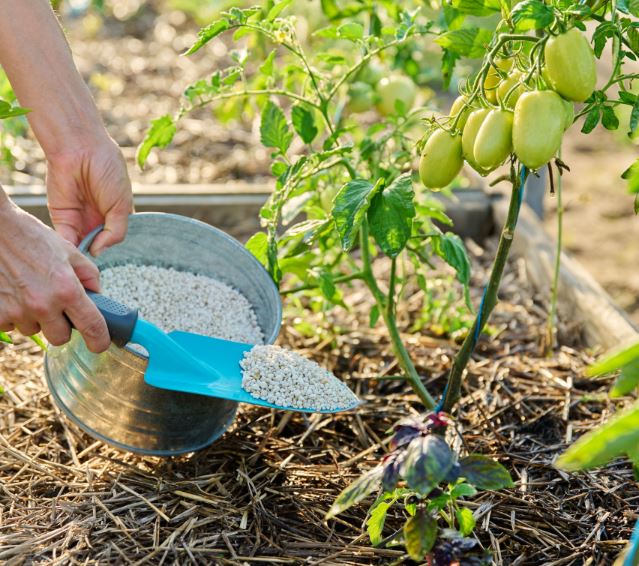
Application method affects how efficiently plants absorb nutrients. Different methods suit different situations.
Side-Dressing
Side-dressing involves applying fertilizer alongside the row of plants, not directly on the stem. When the first fruits start to enlarge, apply fertilizer in a six-inch wide band alongside the row and scratch it into the surface of the soil. For young plants, place fertilizer in a circle 3 inches away from the plant and 3 to 4 inches deep. An additional application of nitrogen about fruit set time, placed in a circle 1 foot away from the plant, helps sustain production.
Fertigation
Fertigation applies fertilizer through irrigation water, delivering nutrients directly to the root zone. For long-cycle tomatoes, adjust NPK ratios with water-soluble fertilizers throughout the season. A target yield of 400 t/ha requires roughly 1,000 kg N/ha over the entire cropping period. Recommended dose of fertilizer for commercial production is 300 kg N, 150 kg P₂O₅, and 150 kg K₂O per hectare.
Fertilizer application methods:
- Side-dressing: Apply granular fertilizer alongside plants; scratch into soil surface
- Fertigation: Apply water-soluble fertilizer through irrigation; ideal for containers
- Foliar spray: Apply diluted fertilizer directly to leaves for rapid correction
- Basal application: Incorporate fertilizer into soil before planting
Foliar Feeding
Foliar sprays deliver nutrients directly through leaves for rapid correction of deficiencies. Spray calcium nitrate or calcium chloride at 30g in 20 litres of water every 7–10 days to prevent blossom end rot. Foliar spray of ZnSO₄ at 0.5% thrice at 10-day intervals from 40 days after planting. Always test a leaf first and follow recommended dilution rates.
Timing Considerations
Apply entire phosphorus as basal before planting. Apply nitrogen in four equal splits (basal, 30, 45, and 60 days after planting). Apply 2/5 of potassium as basal and the remaining potassium in 3 equal splits at 30, 45, and 60 days after planting. For organic fertilizer, apply 30g (N:P:K = 4:3:3), 8g of bone meal, and 8g of natural potassium fertilizer to each hole beside the plants until the fruiting period ends.
Common NPK Problems and Solutions
Recognizing nutrient problems early allows you to take corrective action before yields suffer.
Nitrogen Deficiency
Nitrogen deficiency appears as yellowing leaves, starting with older leaves. Plants are stunted with poor growth. The solution is to increase nitrogen application during vegetative growth. Apply a balanced or nitrogen-rich fertilizer like 10-5-5 or 12-6-6. For organic gardens, side-dress with blood meal.
Excess Nitrogen
Excess nitrogen results in lush plants with dark green foliage and delayed maturity. Plants have long internodes, dark lush leaves, few small fruits, and delayed ripening. Stop nitrogen applications immediately and switch to a bloom/fruiting formula with higher phosphorus and potassium. Excessive nitrogen can also cause pith necrosis—brown lesions on stems and brown tissue in the middle of stems.
Nutrient deficiency and excess symptoms:
- Nitrogen deficiency: Yellowing older leaves; stunted growth
- Nitrogen excess: Dark lush foliage; few fruits; delayed ripening; pith necrosis
- Phosphorus deficiency: Poor root growth; little flowering; purplish stems
- Potassium deficiency: Leaf-edge yellowing and browning; poor fruit set
- Magnesium deficiency: Yellow blotches between leaf veins; veins stay green
- Blossom end rot: Dark spots on fruit bottoms; calcium deficiency
Phosphorus Deficiency
Phosphorus deficiency causes poor root growth, little flowering, and purplish stems or leaves. Apply high-phosphorus fertilizer at transplant and early bloom. Use bone meal or a starter fertilizer high in phosphorus.
Potassium Deficiency
Potassium deficiency appears as scorching or burning on older leaf margins. Fruit set is poor and ripening is uneven. Increase potassium during bloom and fruiting. Apply potassium sulfate or a high-potassium fertilizer like 5-10-20 or 10-10-20.
Blossom End Rot
Blossom end rot appears as dark, sunken spots on the bottom of fruit. It is caused by calcium deficiency, but can occur in soils with adequate calcium—the main problem is inconsistent watering. Excessive ammoniacal nitrogen, potassium, or magnesium fertilization can make calcium unavailable. Maintain even soil moisture and use calcium-rich fertilizers. Spray with calcium nitrate at 30g in 20 litres of water every 7–10 days.
Soil Testing: The Foundation of NPK Planning
Without a soil test, fertilizing is guesswork. Testing tells you exactly what your soil needs.
Why Test Your Soil
A soil test shows NPK estimates, extractable phosphorus and potassium (ppm), pH, organic matter, and CEC. These numbers tell you what to add and what to avoid. Adding fertilizer without a soil test may be a waste of money and may cause problems if you end up over-fertilizing.
Interpreting Soil Test Results
Tomatoes prefer pH about 6.0–6.8. Below that, phosphorus, calcium, and magnesium become less available; above it, iron and manganese availability drops. Low phosphorus means add bone meal or rock phosphate. Low potassium calls for kelp, wood ash, or potassium sulfate. Low calcium points to gypsum or lime.
Adjusting Soil pH
Raise pH with lime, following soil test dosage recommendations. Lower pH with sulfur. Lime also adds calcium and magnesium. Many Minnesota soils have enough phosphorus, so use a low- or no-phosphorus fertilizer unless a soil test recommends additional phosphorus.
When to Test
Test soil 2–4 weeks before planting to allow time for pH adjustments. For containers, test the potting mix or use fertilizers designed for containers. In Kalamazoo County, sandy loam soils often have adequate phosphorus but low potassium, making ratios like 3-1-5, 4-1-6, or 5-2-8 the safest choice.
Fertilizer Schedule for Container Tomatoes
Container tomatoes have unique NPK needs because nutrients leach out with frequent watering. They require more frequent feeding than in-ground plants.
Why Containers Need Different Feeding
Container plants have limited soil volume and cannot access nutrients beyond the pot. Frequent watering leaches nutrients from the potting mix. Container tomatoes often need fertilizer every 7–10 days at label strength.
Container Fertilizer Schedule
At planting, mix slow-release fertilizer into the potting mix or use a potting soil with fertilizer already incorporated. During weeks 1–4, apply liquid fertilizer every 1–2 weeks. After the first truss has set (when flowers have formed small green tomatoes behind them), apply feed once a week. Switch to a potassium-rich formula during fruiting.
NPK Ratios for Containers
Use a starter with modest nitrogen and elevated phosphorus at transplant. During vegetative growth, use a balanced liquid fertilizer. During flowering and fruiting, use a formula with lower nitrogen and higher potassium, like 5-10-10 or 10-10-20.
Frequently Asked Questions About NPK for Tomatoes
1. What is the best NPK ratio for tomatoes?
The best NPK ratio depends on the growth stage. For seedlings/transplants, use 3-10-10 to 5-10-10. For vegetative growth, use 10-5-5 to 12-6-6. For flowering, use 10-20-10, 5-10-10, or 3-12-12. For fruiting, use 10-10-20 or 5-10-20. In potassium-deficient soils, ratios like 3-1-5, 4-1-6, or 5-2-8 are recommended.
2. How often should I fertilize tomatoes with NPK?
For in-ground tomatoes, apply fertilizer at planting, side-dress when first fruits enlarge, and apply additional nitrogen at fruit set. For container tomatoes, feed weekly after the first truss sets. Always follow soil test recommendations when available.
3. Can I use 10-10-10 fertilizer for tomatoes?
Yes, 10-10-10 can be used as a balanced fertilizer during vegetative growth. However, it is not ideal for all stages. At transplant, a higher phosphorus formula like 5-10-5 or 4-12-4 is better. During fruiting, a lower nitrogen, higher potassium formula like 5-10-20 is preferred.
4. What happens if I use too much nitrogen on tomatoes?
Too much nitrogen causes lush, dark green foliage with few flowers and fruits. Plants have long internodes and delayed ripening. Excessive nitrogen can also lead to pith necrosis, a bacterial infection. Stop nitrogen applications and switch to a bloom/fruiting formula with higher phosphorus and potassium.
5. How do I prevent blossom end rot with NPK fertilization?
Blossom end rot is caused by calcium deficiency, often from inconsistent watering rather than low soil calcium. Maintain even soil moisture and use calcium-rich fertilizers. Excessive ammoniacal nitrogen, potassium, or magnesium can make calcium unavailable. Spray with calcium nitrate at 30g in 20 litres of water every 7–10 days.
6. Do organic NPK fertilizers work as well as synthetic ones?
Research shows that application of 100% of recommended NPK using organic NPK granules is the best approach to improve tomato fruit quality and enhance soil fertility. Organic fertilizers improve soil health over time, while synthetics provide faster nutrient availability. Both can support healthy tomato plants when used correctly.
NPK Ratios by Tomato Growth Stage
| Growth Stage | Timing | Recommended NPK Ratio | Key Nutrient Focus |
|---|---|---|---|
| Seedling/Transplant | At planting | 3-10-10 to 5-10-10 | High phosphorus for roots |
| Vegetative Growth | Weeks 3–4 | 10-5-5, 10-10-10, or 12-6-6 | Moderate to high nitrogen |
| Flowering | First flowers appear | 10-20-10, 5-10-10, or 3-12-12 | Reduce N; increase P and K |
| Fruit Set | Small fruits appear | 10-10-20, 5-10-20, or 4-8-12 | Low nitrogen; high potassium |
| Ripening | Final 2–4 weeks | Higher K blends; 0-10-10 | Potassium for flavor |
Final Verdict: Mastering NPK for Tomatoes
NPK fertilization is the cornerstone of successful tomato growing. The key is matching nutrient ratios to growth stages—phosphorus for roots and blooms, nitrogen for foliage, and potassium for fruit quality. Start with a soil test to understand your baseline fertility. At transplant, use a high-phosphorus starter to encourage root establishment. During vegetative growth, switch to a balanced or nitrogen-rich formula to build canopy. When flowers appear, reduce nitrogen and increase phosphorus and potassium. During fruiting and ripening, prioritize potassium for fruit size, flavor, and color.
For in-ground gardens, apply phosphorus at planting and split nitrogen and potassium applications throughout the season. For container gardens, feed weekly with water-soluble fertilizer. Watch for warning signs—yellowing leaves indicate nitrogen deficiency; purplish stems suggest phosphorus deficiency; leaf-edge browning points to potassium deficiency; and blossom end rot signals calcium problems. The extra attention you invest in proper NPK management pays dividends—healthier plants, larger fruits, and the sweetest, most flavorful tomatoes you have ever grown.

- How to Grow Microgreens Without Soil Indoors: Easy Home Method - October 5, 2026
- Microgreens vs. Sprouts: Key Differences, Nutrition, Safety, and Which One to Eat - October 5, 2026
- 10 Best Garden Tools For Weed Removal 2027 - October 3, 2026