Plant Parts Labelled: Learn Root, Stem, Leaf, Flower, Fruit, and Seed
The main parts of a plant are the roots, stem, leaves, flowers, fruits, and seeds. Each part has a specific function that helps the plant grow, reproduce, and survive. Roots absorb water and nutrients, the stem supports the plant and transports water, leaves make food through photosynthesis, flowers produce seeds, fruits protect the seeds, and seeds grow into new plants. Learning the labelled parts of a plant makes it easier to understand plant biology, gardening, and agriculture. In this guide, you’ll explore each plant part, its function, and how they work together, along with easy-to-understand explanations and labeled plant diagrams suitable for students, teachers, and gardening enthusiasts.
What Are the Parts of a Plant?
Every plant is made up of several specialized parts that work together to keep it alive, healthy, and growing. The main parts of a plant are the roots, stem, leaves, flowers, fruits, and seeds. Each structure has a unique job, such as absorbing water, transporting nutrients, producing food, or helping the plant reproduce. Understanding these parts makes it easier to study plant biology, identify different species, and care for plants in gardens or farms.
Definition of Plant Structure
Plant structure refers to the physical parts, or organs, that make up a plant and enable it to survive. These organs are organized into two main systems: the root system, which grows below the ground, and the shoot system, which develops above the ground. Each system performs specialized tasks, but they work together to ensure the plant receives water, nutrients, sunlight, and energy. A clear understanding of plant structure provides the foundation for learning about plant growth, photosynthesis, and reproduction.
Main Parts of a Plant Explained
Plants contain several major organs, each designed to perform a specific function that supports growth and survival.
| Plant Part | Main Function |
|---|---|
| Roots | Absorb water and minerals while anchoring the plant |
| Stem | Supports the plant and transports water and nutrients |
| Leaves | Produce food through photosynthesis |
| Flowers | Carry out reproduction and produce seeds |
| Fruits | Protect and disperse seeds |
| Seeds | Grow into new plants under suitable conditions |
These parts depend on one another. Healthy roots supply water to the stem, the stem delivers it to the leaves, the leaves produce food, and flowers and fruits help create the next generation of plants.
Why Labeling Plant Parts Is Important
Labeling the parts of a plant is one of the simplest ways to understand plant anatomy. Diagrams with labeled structures help students, gardeners, and beginners recognize each organ and learn its purpose. Knowing the names of plant parts also improves communication when studying biology or solving plant health problems.
Benefits of labeling plant parts include:
- Makes plant anatomy easier to understand.
- Improves science learning and classroom activities.
- Helps identify plant diseases or damage.
- Supports gardening and agricultural practices.
- Builds observation and identification skills.
Basic Plant Anatomy for Beginners
Basic plant anatomy focuses on learning the visible structures of a plant before exploring its internal tissues. Beginners usually start by identifying the roots, stem, leaves, flowers, fruits, and seeds, then learning how each part contributes to the plant’s survival.
The two main plant systems include:
- Root system – Anchors the plant and absorbs water and nutrients.
- Shoot system – Includes the stem, leaves, flowers, fruits, and seeds that support growth, food production, and reproduction.
Learning these basic structures provides a strong foundation for understanding how plants grow and function.
Root System of a Plant
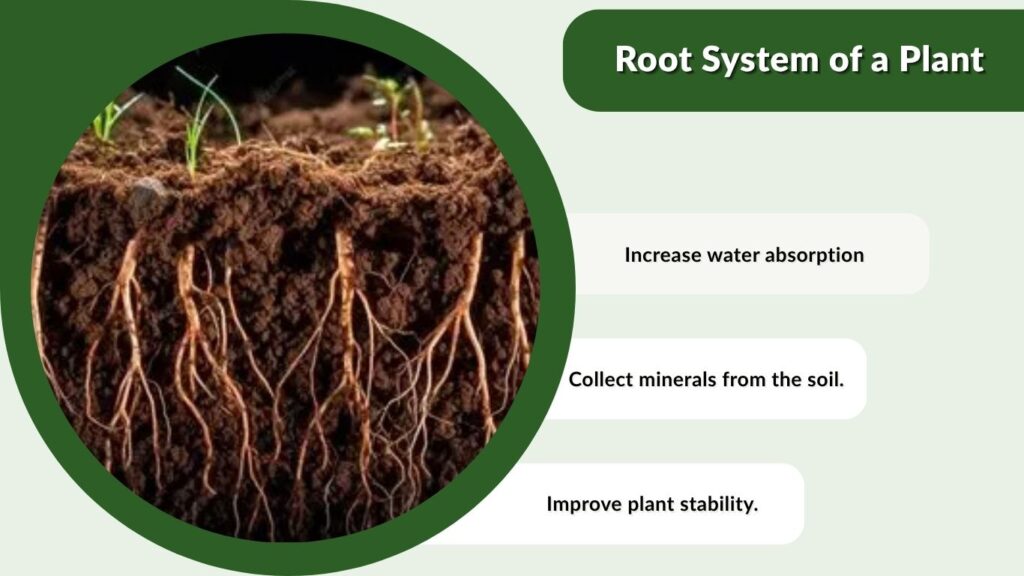
The root system is the underground portion of a plant that anchors it firmly in the soil while absorbing water and essential minerals. Roots also store food in many plant species and form beneficial relationships with soil microorganisms. A healthy root system is essential because it supplies the water and nutrients needed for every stage of plant growth.
Primary Root and Secondary Roots
The primary root is the first root that emerges from a germinating seed. In many plants, it develops into a thick taproot that grows deep into the soil. As the plant matures, secondary or lateral roots branch from the primary root, creating a larger network underground.
Together, these roots:
- Increase water absorption.
- Collect minerals from the soil.
- Improve plant stability.
- Support continued growth.
This branching system allows plants to explore a much larger volume of soil for nutrients.
Root Hairs and Their Function
Root hairs are tiny extensions that grow from young roots near the root tip. Although they are microscopic, they greatly increase the root’s surface area, making water and mineral absorption far more efficient.
Their main functions include:
- Absorbing water from the soil.
- Taking in dissolved minerals.
- Increasing nutrient uptake.
- Supporting healthy root development.
Without root hairs, plants would struggle to absorb enough resources for proper growth.
Types of Root Systems (Taproot vs Fibrous)
Most plants develop one of two main root systems: taproot or fibrous roots.
| Taproot System | Fibrous Root System |
|---|---|
| One thick central root | Many thin roots of similar size |
| Grows deep into the soil | Spreads close to the soil surface |
| Stores food efficiently | Excellent for preventing soil erosion |
| Found in carrots and radishes | Found in grasses, wheat, and rice |
The type of root system depends on the plant species and helps it adapt to different growing conditions.
How Roots Support Plant Growth
Roots perform several essential functions that keep plants healthy throughout their life cycle. Besides anchoring the plant, they continuously absorb water and minerals needed for photosynthesis, growth, and reproduction.
Roots support plant growth by:
- Holding the plant securely in place.
- Absorbing water and nutrients.
- Storing food reserves.
- Supplying water to stems and leaves.
- Working with beneficial soil microbes.
Strong roots form the foundation for healthy stems, leaves, flowers, and fruits.
Stem and Its Functions
The stem is the central support structure of the plant’s shoot system. It connects the roots to the leaves, flowers, and fruits while transporting water, minerals, and food throughout the plant. Without a healthy stem, plants cannot efficiently distribute the resources needed for growth.
Structure of the Stem
A plant stem contains several important parts that support growth and transport materials throughout the plant.
The main stem structures include:
- Nodes where leaves and buds develop.
- Internodes between the nodes.
- Terminal buds at the growing tip.
- Vascular tissues called xylem and phloem.
- Protective outer epidermis.
As plants mature, stems may remain soft and green or become woody depending on the species.
Transport of Water and Nutrients
The stem acts like a transportation system, moving materials between different parts of the plant.
Its vascular tissues perform two important jobs:
- Xylem carries water and minerals upward from the roots.
- Phloem transports sugars produced in the leaves to growing tissues and storage organs.
This continuous movement keeps every plant organ supplied with the resources it needs.
Supporting Leaves, Flowers, and Fruits
The stem provides physical support for all above-ground plant organs. It positions leaves where they receive maximum sunlight and holds flowers high enough to attract pollinators.
The stem also:
- Supports developing fruits.
- Holds branches upright.
- Protects internal transport tissues.
- Helps plants grow toward sunlight.
Strong stems improve both plant stability and productivity.
Types of Stems in Plants
Plants have different stem types based on their growth habits and environments.
Common stem types include:
- Herbaceous stems that are soft and green.
- Woody stems found in shrubs and trees.
- Underground stems such as tubers, bulbs, and rhizomes.
- Climbing stems that attach to supports.
- Creeping stems that spread along the ground.
Each type is adapted to help plants survive in different conditions.
Leaves and Their Parts
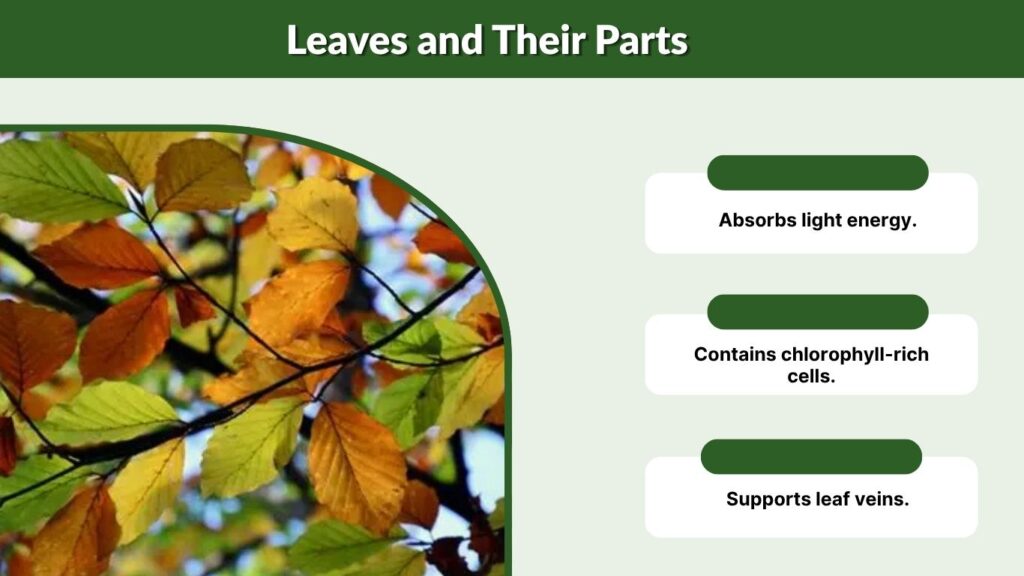
Leaves are the primary food-producing organs of plants. They capture sunlight and convert it into energy through photosynthesis while also regulating water loss and exchanging gases with the atmosphere. Their structure is specially adapted to maximize these important functions.
Leaf Blade (Lamina)
The leaf blade, also called the lamina, is the broad, flat portion of the leaf. Its large surface area allows it to capture sunlight efficiently and perform photosynthesis.
The lamina also:
- Absorbs light energy.
- Contains chlorophyll-rich cells.
- Supports leaf veins.
- Facilitates gas exchange.
Its flat shape helps maximize the amount of sunlight available for food production.
Petiole and Leaf Veins
The petiole is the stalk that connects the leaf blade to the stem, while the veins form a branching network throughout the leaf.
Together they:
- Support the leaf blade.
- Transport water through xylem.
- Carry sugars through phloem.
- Strengthen the leaf structure.
The arrangement of leaf veins also helps scientists identify different plant species.
Stomata and Gas Exchange
Stomata are tiny pores found mainly on the lower surface of leaves. They open and close with the help of guard cells to regulate gas exchange and water loss.
Their primary functions include:
- Allowing carbon dioxide to enter.
- Releasing oxygen into the atmosphere.
- Controlling water vapor loss.
- Maintaining the plant’s water balance.
Efficient stomatal activity is essential for healthy photosynthesis and plant growth.
Photosynthesis and Leaf Functions
Photosynthesis is the process through which leaves produce food for the plant using sunlight, water, and carbon dioxide. Chlorophyll inside the leaf captures light energy and converts it into glucose, which fuels plant growth, while oxygen is released into the atmosphere.
Besides photosynthesis, leaves perform several other important functions:
- Produce energy-rich sugars.
- Regulate water through transpiration.
- Exchange gases with the environment.
- Store water or nutrients in some plant species.
- Help cool the plant during hot weather.
These functions make leaves one of the most important organs for plant survival, growth, and reproduction.
Flower Parts Labelled
Flowers are the reproductive organs of flowering plants. Each flower contains several specialized parts that work together to attract pollinators, produce seeds, and ensure the continuation of the plant species. Learning the labeled parts of a flower helps students understand how pollination and fertilization occur.
Sepals and Petals
Sepals and petals are the outermost parts of a flower. Although they are located close together, they perform different functions during the flower’s development.
Sepals are usually green, leaf-like structures that protect the flower bud before it opens. They also support the flower after blooming.
Petals are often brightly colored and fragrant. Their main purpose is to attract pollinators such as bees, butterflies, birds, and other insects.
Key functions include:
- Sepals protect developing flower buds.
- Petals attract pollinators with color and scent.
- Petals provide a landing platform for insects.
- Together they help increase successful pollination.
Stamen (Anther and Filament)
The stamen is the male reproductive part of a flower. It consists of two main structures: the anther and the filament.
The filament is a slender stalk that holds the anther in position. The anther produces and releases pollen grains, which contain the male reproductive cells.
The stamen performs several important functions:
- Produces pollen.
- Supports pollen release.
- Positions the anther for pollinators or wind.
- Enables fertilization by supplying male gametes.
Without healthy stamens, flowering plants cannot produce viable pollen.
Pistil or Carpel (Stigma, Style, Ovary)
The pistil, also called the carpel, is the female reproductive organ of a flower. It consists of three major parts: the stigma, style, and ovary.
- Stigma – Sticky surface that captures pollen.
- Style – A narrow tube connecting the stigma to the ovary.
- Ovary – Contains ovules that develop into seeds after fertilization.
Together these structures:
- Receive pollen.
- Guide pollen tubes toward the ovules.
- Protect developing ovules.
- Produce seeds and eventually fruits after fertilization.
Pollination and Fertilization
Pollination is the transfer of pollen from the anther to the stigma. It may occur through insects, birds, wind, water, or other pollinators.
After pollination:
- A pollen grain lands on the stigma.
- A pollen tube grows through the style.
- Male reproductive cells travel to the ovule.
- Fertilization occurs inside the ovary.
- The ovule develops into a seed.
- The ovary develops into a fruit.
This reproductive process allows flowering plants to produce the next generation.
Fruit and Seed Structure
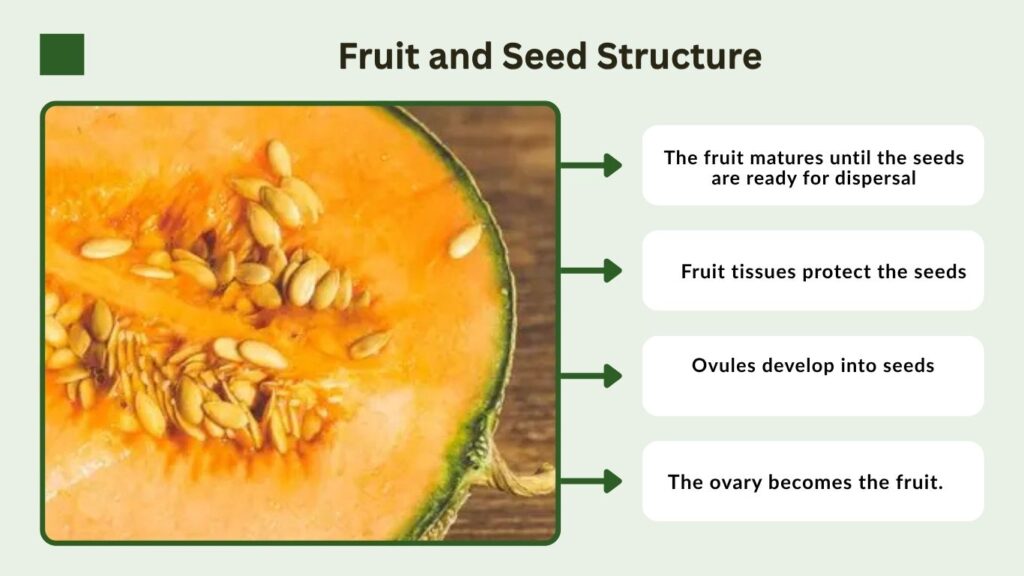
After successful fertilization, the flower begins transforming into a fruit that protects the developing seeds. Fruits and seeds are essential because they help plants reproduce, spread to new locations, and survive across generations.
Fruit Development After Fertilization
Once fertilization is complete, the flower changes dramatically. The petals usually fall off, while the ovary enlarges and develops into a fruit.
During fruit development:
- The ovary becomes the fruit.
- Ovules develop into seeds.
- Fruit tissues protect the seeds.
- The fruit matures until the seeds are ready for dispersal.
Different plants produce many fruit types, including fleshy fruits like apples and dry fruits such as beans and peas.
Seed Coat, Embryo, and Cotyledon
A seed contains all the structures needed to produce a new plant.
Its main parts include:
| Seed Part | Function |
|---|---|
| Seed coat | Protects the seed from damage and drying |
| Embryo | Develops into the new plant |
| Cotyledon | Stores or supplies food for early growth |
These parts work together to help the seed survive until conditions are suitable for germination.
Seed Dispersal Methods
Plants use various methods to spread their seeds away from the parent plant, reducing competition for sunlight, water, and nutrients.
Common seed dispersal methods include:
- Wind dispersal.
- Water dispersal.
- Animal dispersal.
- Explosive seed pods.
- Gravity.
Each method increases the chances that seeds will germinate in a favorable environment.
Importance of Fruits and Seeds
Fruits and seeds play a vital role in the life cycle of flowering plants. Fruits protect developing seeds and often help distribute them over long distances.
Their importance includes:
- Ensuring plant reproduction.
- Protecting young embryos.
- Helping seeds spread to new habitats.
- Providing food for humans and wildlife.
- Supporting biodiversity and ecosystem health.
Without fruits and seeds, many plant species could not continue their life cycle.
Functions of Each Plant Part
Every part of a plant performs a specific role that contributes to the plant’s overall health and survival. Together, these organs absorb resources, produce food, transport nutrients, and enable reproduction.
Root Functions
Roots are responsible for supporting the plant below the soil surface while collecting essential resources.
Their major functions include:
- Anchoring the plant firmly.
- Absorbing water.
- Taking up minerals.
- Storing food in some species.
- Working with beneficial soil microorganisms.
Healthy roots provide the foundation for strong plant growth.
Stem Functions
The stem serves as both a support structure and a transport system.
Its primary functions are:
- Supporting leaves, flowers, and fruits.
- Carrying water through xylem.
- Transporting sugars through phloem.
- Producing new branches and buds.
- Positioning leaves toward sunlight.
A strong stem allows plants to grow upright and efficiently distribute nutrients.
Leaf Functions
Leaves are the primary food factories of plants because they perform photosynthesis.
Additional functions include:
- Capturing sunlight.
- Producing glucose.
- Exchanging gases.
- Regulating water loss.
- Cooling the plant through transpiration.
Healthy leaves directly influence plant growth and productivity.
Flower, Fruit, and Seed Functions
These reproductive structures ensure the survival of plant species.
Their functions include:
- Flowers produce pollen and ovules for reproduction.
- Fruits protect developing seeds and aid seed dispersal.
- Seeds contain embryos that grow into new plants.
Together, they complete the plant’s reproductive cycle and maintain future generations.
Plant Parts Labelled Diagram Explained
A labeled plant diagram provides a clear visual representation of each plant organ and its location. These diagrams are widely used in classrooms, textbooks, and gardening guides because they make learning plant anatomy easier and more engaging.
How to Read a Labeled Plant Diagram
When reading a labeled plant diagram, begin at the bottom with the roots and move upward through the stem, leaves, flowers, fruits, and seeds.
Follow these steps:
- Identify the root system below the soil.
- Locate the stem connecting all plant parts.
- Find the leaves attached to the stem.
- Observe the flower and its reproductive structures.
- Identify the fruit and seeds if present.
Following the diagram from bottom to top helps learners understand how each part is connected.
Common Labels Found in Plant Illustrations
Most educational plant diagrams include labels for the major organs and important flower structures.
Common labels include:
- Roots
- Root hairs
- Stem
- Nodes
- Leaves
- Petiole
- Leaf veins
- Flower
- Sepal
- Petal
- Stamen
- Anther
- Filament
- Pistil
- Stigma
- Style
- Ovary
- Fruit
- Seed
These labels help learners quickly identify each structure and its function.
Differences Between Simple and Detailed Diagrams
Plant diagrams vary depending on the learning level.
| Simple Diagram | Detailed Diagram |
|---|---|
| Shows only major plant parts | Includes internal flower and seed structures |
| Best for beginners | Best for advanced biology students |
| Fewer labels | More anatomical labels |
| Easy to memorize | Provides deeper scientific understanding |
Both diagram types are valuable, depending on the learner’s experience and educational goals.
Tips for Memorizing Plant Parts
Learning plant anatomy becomes much easier with regular practice and visual learning techniques.
Helpful tips include:
- Study labeled diagrams every day.
- Learn one plant organ at a time.
- Match each part with its function.
- Practice drawing and labeling plants from memory.
- Use flashcards or quizzes for review.
- Observe real plants while identifying each structure.
Combining diagrams with hands-on observation helps build a lasting understanding of plant parts and their functions.
Differences Between Plant Parts
Each part of a plant has a specialized structure and function. Although all plant organs work together to keep the plant alive, they differ in appearance, location, and purpose. Understanding these differences makes it easier to identify plant parts and learn how plants grow and reproduce.
Root vs Stem
Roots and stems are both essential plant organs, but they perform very different roles. Roots grow below the soil to absorb water and anchor the plant, while stems grow above the ground to support leaves, flowers, and fruits.
| Root | Stem |
|---|---|
| Usually grows underground | Usually grows above ground |
| Absorbs water and minerals | Transports water and nutrients |
| Anchors the plant | Supports leaves, flowers, and fruits |
| Contains root hairs | Contains nodes and internodes |
| Stores food in some plants | Produces branches and buds |
Together, roots and stems form the transport system that keeps the plant healthy and growing.
Stem vs Leaf
The stem and leaves work closely together, but they have different structures and responsibilities. The stem acts as the plant’s support and transportation system, while the leaves are responsible for producing food.
Key differences include:
- Stem supports the entire shoot system.
- Stem transports water through xylem and food through phloem.
- Leaves contain chlorophyll for photosynthesis.
- Leaves exchange gases through stomata.
- Leaves regulate water loss through transpiration.
Without stems, leaves could not receive water, and without leaves, stems would have no food to transport.
Flower vs Fruit
Flowers and fruits are both reproductive structures, but they develop at different stages of the plant’s life cycle.
| Flower | Fruit |
|---|---|
| Reproductive organ | Develops after fertilization |
| Produces pollen and ovules | Protects developing seeds |
| Attracts pollinators | Helps disperse seeds |
| Exists before fertilization | Forms after fertilization |
| Produces seeds indirectly | Contains mature seeds |
Flowers begin the reproductive process, while fruits complete it by protecting and spreading seeds.
Monocot vs Dicot Plant Structures
Flowering plants are commonly divided into monocots and dicots based on their seed and structural characteristics.
| Monocot | Dicot |
|---|---|
| One cotyledon | Two cotyledons |
| Parallel leaf veins | Branched leaf veins |
| Fibrous root system | Taproot system |
| Flower parts in multiples of three | Flower parts in multiples of four or five |
| Scattered vascular bundles | Vascular bundles arranged in a ring |
Recognizing these structural differences helps classify flowering plants and understand their growth patterns.
Plant Growth From Root to Fruit
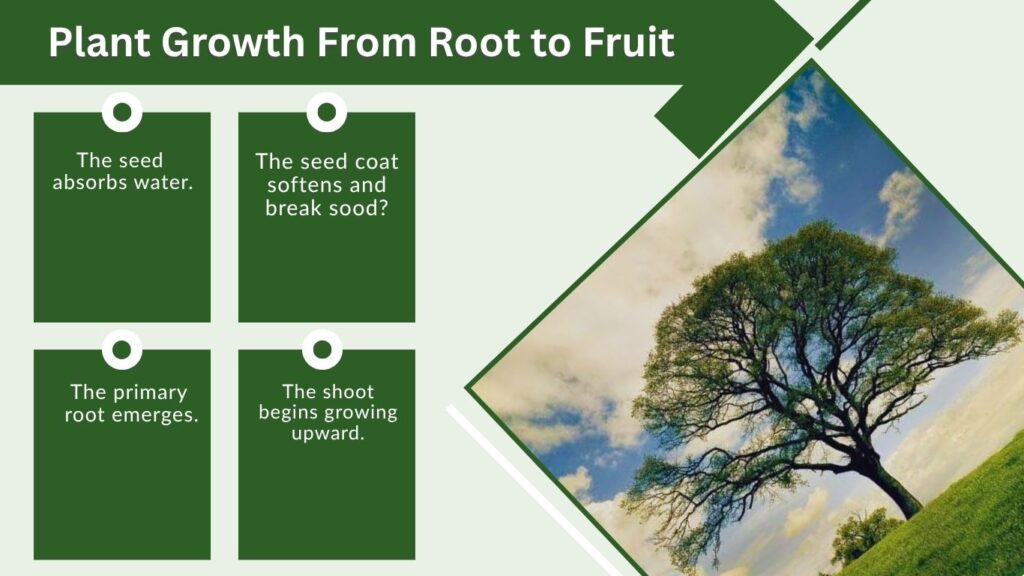
Plants go through a series of growth stages during their life cycle. Beginning as a seed, they develop roots, stems, leaves, flowers, and eventually fruits containing new seeds. Each stage prepares the plant for the next phase of growth and reproduction.
Seed Germination Stages
Seed germination is the process in which a dormant seed begins to grow under favorable conditions.
The main stages include:
- The seed absorbs water.
- The seed coat softens and breaks.
- The primary root emerges.
- The shoot begins growing upward.
- The first leaves develop.
Germination marks the beginning of a plant’s life and establishes the root and shoot systems.
Vegetative Growth
After germination, the plant enters the vegetative growth stage. During this period, it focuses on producing roots, stems, and leaves.
The plant uses sunlight, water, and nutrients to:
- Expand its root system.
- Grow taller stems.
- Produce more leaves.
- Build energy through photosynthesis.
- Prepare for flowering.
Healthy vegetative growth creates a strong foundation for successful reproduction.
Flowering Stage
Once the plant reaches maturity, it begins producing flowers.
During this stage:
- Flower buds develop.
- Petals open to attract pollinators.
- Stamens produce pollen.
- Pistils receive pollen.
- Pollination and fertilization occur.
Flowers play the central role in producing seeds and initiating fruit development.
Fruit and Seed Production
After fertilization, the flower transforms into a fruit while the ovules develop into seeds.
The fruit protects the seeds until they mature and are ready for dispersal.
This stage allows plants to:
- Produce healthy seeds.
- Protect developing embryos.
- Spread offspring to new locations.
- Continue the plant life cycle.
Successful fruit and seed production ensures the survival of future plant generations.
Importance of Learning Plant Parts
Understanding plant parts helps people appreciate how plants function and interact with their environment. Whether you are a student, gardener, farmer, or nature enthusiast, learning plant anatomy improves observation skills and supports better plant care.
Benefits for Students
Learning the parts of a plant provides students with a strong foundation in biology and environmental science.
Benefits include:
- Improves understanding of plant life cycles.
- Supports science classroom activities.
- Makes diagrams easier to interpret.
- Builds scientific vocabulary.
- Encourages observation and critical thinking.
Plant anatomy is one of the first topics introduced in basic biology because it explains how living organisms grow and survive.
Gardening and Farming Applications
Knowing the functions of plant parts helps gardeners and farmers make better decisions about plant care.
Understanding plant anatomy helps with:
- Proper watering.
- Fertilizer application.
- Pruning techniques.
- Pest identification.
- Diagnosing nutrient deficiencies.
Healthy roots, stems, and leaves contribute directly to stronger plants and better harvests.
Plant Identification Skills
Plant structures are important tools for identifying different species.
Features commonly used include:
- Leaf shape and vein pattern.
- Stem type.
- Root system.
- Flower structure.
- Fruit and seed characteristics.
These characteristics allow botanists, gardeners, and students to distinguish one plant from another.
Understanding Plant Health
Each plant organ provides clues about the plant’s overall health.
For example:
- Yellow leaves may indicate nutrient deficiencies.
- Weak stems can result from insufficient light.
- Damaged roots often reduce water absorption.
- Poor flowering may signal environmental stress.
Recognizing these signs helps diagnose problems early and improve plant care.
Frequently Asked Questions About Plant Parts
Understanding the basic parts of a plant often raises common questions about their structure and function. Here are answers to some of the most frequently asked questions.
What Are the 6 Main Parts of a Plant?
The six main parts of a flowering plant are roots, stem, leaves, flowers, fruits, and seeds. Each performs a unique role in helping the plant survive and reproduce. Roots absorb water, stems provide support and transport materials, leaves produce food, flowers enable reproduction, fruits protect seeds, and seeds grow into new plants.
Which Plant Part Makes Food?
Leaves are the primary food-producing organs of a plant.
Inside the leaves, chlorophyll captures sunlight and uses it to convert water and carbon dioxide into glucose through photosynthesis.
The food produced in the leaves is transported to other parts of the plant to support growth, flowering, fruit development, and seed production.
What Is the Function of Roots?
Roots perform several essential functions that keep the plant healthy and stable.
Their primary roles include:
- Absorbing water from the soil.
- Taking in minerals and nutrients.
- Anchoring the plant firmly.
- Storing food in some species.
- Supporting relationships with beneficial soil microorganisms.
A healthy root system is the foundation of strong plant growth.
Why Do Flowers Produce Seeds?
Flowers produce seeds because they are the reproductive organs of flowering plants. After pollination and fertilization, the ovules inside the flower’s ovary develop into seeds, each containing an embryo capable of growing into a new plant.
Seeds help plants:
- Reproduce successfully.
- Preserve genetic information.
- Spread to new environments.
- Survive unfavorable conditions until germination.
- Continue the plant life cycle for future generations.

- 10 Best Garden Hose For Nursery Plants 2026 - October 22, 2026
- 10 Best Garden Hose For Hedge Watering 2026 - October 22, 2026
- 10 Best Garden Hose For Shrub Watering 2026 - October 22, 2026