Growing tomatoes in containers is a rewarding way to enjoy fresh, homegrown fruit even without a backyard. The short answer: To grow tomatoes successfully in containers, use a pot at least 12–18 inches deep with drainage holes, choose compact determinate or dwarf varieties, fill with premium potting mix (never garden soil), water daily during fruiting, feed weekly with balanced fertilizer, and provide 6–8 hours of full sun. Container gardening gives you control over soil quality, mobility to chase sunlight, and protection from soil-borne diseases. Whether you have a balcony, patio, or small courtyard, these techniques will help you harvest juicy, flavorful tomatoes all season long.
Why Grow Tomatoes in Containers?
Container gardening offers unique advantages for tomato cultivation, especially for urban gardeners and those with challenging soil conditions.
Space Efficiency
Containers make tomato growing possible in limited spaces—balconies, patios, decks, rooftops, and small courtyards. You can grow tomatoes virtually anywhere there is sunlight, from a tiny apartment balcony to a shared community garden space. This accessibility has made tomatoes the most popular homegrown produce, found in 86% of food gardens.
Soil Control and Quality
Container gardening allows you to use high-quality, disease-free soil tailored specifically for tomatoes. You avoid the problems of heavy clay, poor drainage, or contaminated garden soil. This control means healthier plants and better yields from the start.
Mobility and Flexibility
Containers can be moved to optimize sunlight exposure as the season changes. You can shift plants to follow the sun, protect them from harsh weather, or move them to a sheltered spot during storms. This flexibility is invaluable in regions with unpredictable weather.
Key benefits of container tomato growing:
- Perfect for small spaces and urban gardens
- Complete control over soil quality and nutrients
- Mobility to chase sunlight and avoid weather extremes
- Reduced pest and disease problems from soil-borne pathogens
- Faster soil warming in spring for earlier harvests
- Easier access for watering, pruning, and harvesting
Reduced Pest and Disease Problems
Elevated containers reduce exposure to soil-borne diseases and ground-dwelling pests. You can spot issues earlier because plants are at eye level. This makes organic pest management more effective and less challenging than in traditional garden beds.
Choosing the Right Container
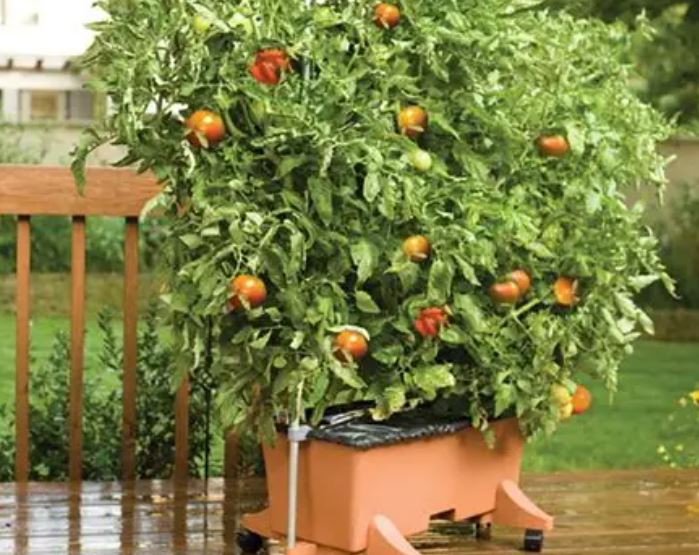
The container you choose is your tomato plant’s entire environment—it must provide space, drainage, and protection.
Container Size Requirements
Tomatoes need deep soil for extensive root systems. The minimum depth is 12 inches, with 12–18 inches recommended. For most determinate varieties, aim for 18–24 inches deep and wide. Indeterminate varieties need larger containers—at least 5 gallons, preferably 10–15 gallons.
Container size guidelines:
- Cherry/dwarf patio types: Minimum 30–35 cm diameter and 30 cm deep
- Medium determinate (e.g., Roma): 35–40 cm wide and 35–40 cm deep
- Indeterminate vining tomatoes: 40–50 cm wide and 45–60 cm deep
- General rule: Larger pots hold more moisture and support healthier root systems
Container Materials Comparison
Plastic pots are lightweight, affordable, and retain moisture well, but can overheat in direct sun. Fabric grow bags offer excellent drainage and air-pruning of roots, but dry out faster and need more frequent watering. Ceramic or terracotta pots are stable and attractive but heavy, breakable, and dry out very fast unless glazed inside. Wooden boxes are durable but can rot over time if not treated.
Drainage Is Non-Negotiable
Proper drainage is critical to prevent waterlogging and root rot. Choose pots with at least 3–4 drainage holes at the base. Raise pots slightly on bricks or pot feet to prevent waterlogging. Avoid using trays underneath unless drained regularly. If your container lacks drainage holes, drill several before planting.
When to Install Support
Install stakes, cages, or trellises at planting time to avoid damaging roots later. Use bamboo stakes, steel cages, or vertical trellises for larger plants. Support is essential for indeterminate varieties that can grow 6 feet or more.
Choosing the Best Tomato Varieties for Containers
Not all tomatoes thrive in containers. Selecting the right variety is key to success.
Determinate vs. Indeterminate Varieties
Determinate (bush) tomatoes grow to a compact size (3–4 feet), set fruit all at once, and then stop growing. They are well-suited for containers because of their manageable size. Indeterminate (vining) tomatoes can grow very tall (6 feet or more) and produce fruit continuously. While they can be grown in containers, they require larger pots and strong support.
Best Determinate Varieties for Containers
‘Celebrity’ is a high-yielding variety with crack-resistant fruits and excellent disease resistance, growing 3–4 feet tall. ‘Bush Early Girl’ grows just 2½ to 3 feet tall and produces sweet 3- to 4-inch fruits just two months from transplanting. ‘Patio’ is a dwarf variety with good disease resistance, growing just 2 feet tall and producing a heavy crop of 3- to 4-inch fruits.
Recommended container tomato varieties:
- Cherry: ‘Tiny Tim’, ‘Patio’, ‘Sweet Million’, ‘Tumbling Tom’
- Determinate: ‘Celebrity’, ‘Bush Early Girl’, ‘Roma VF’
- Dwarf: ‘Red Robin’, ‘Patio Roma’, ‘Bush Goliath’
- Sauce: ‘San Marzano’ (indeterminate but grows to 4 feet)
Best Cherry Varieties for Containers
Cherry tomatoes are excellent for containers. ‘Tiny Tim’ and ‘Red Robin’ are extremely compact dwarf varieties. ‘Sweet Million’ produces abundant sweet cherry tomatoes. ‘Tumbling Tom’ is a trailing variety perfect for hanging baskets. Varieties producing smaller tomatoes tend to perform best in containers.
What to Avoid
Avoid large beefsteak varieties and vigorous indeterminates in small containers. These plants need extensive root systems and will become root-bound. If you want to grow indeterminates, use at least 10–15 gallon containers with strong support.
The Perfect Soil Mix for Container Tomatoes
Container soil is different from garden soil. It must be lightweight, well-draining, and nutrient-rich.
Why Garden Soil Fails in Containers
Garden soil is too heavy for containers—it compacts, blocks air movement, and prevents water from reaching roots. It may also harbor diseases and pests. Always use a premium potting mix formulated for vegetables or containers.
Essential Soil Components
A good container mix contains an organic component like peat moss or coconut coir for moisture retention. It needs perlite or vermiculite for drainage and aeration. Compost or well-rotted manure provides nutrients. The ideal pH range is 6.0 to 6.8.
DIY container soil mix recipe:
- 40% high-quality potting mix or compost
- 40% peat moss or coconut coir
- 20% perlite or vermiculite
- Optional: handful of worm castings for microbial life
- Optional: dolomitic lime to balance pH
Amending for Better Results
Mix in organic matter such as compost or well-rotted manure to improve fertility. Add cow manure to a good-quality organic potting mix for extra nutrition. Perlite or vermiculite enhances drainage and aeration. A blend of 1 part compost, 1 part coco peat, and 1 part perlite or coarse sand creates an excellent growing medium.
Pre-Planting Preparation
Fill your container with potting mix, leaving about 2 inches of space at the top for watering. Water the soil lightly before planting. Add a slow-release fertilizer prior to potting up your plant. Moisten the mix thoroughly before planting to ensure even moisture distribution.
Planting Tomatoes in Containers
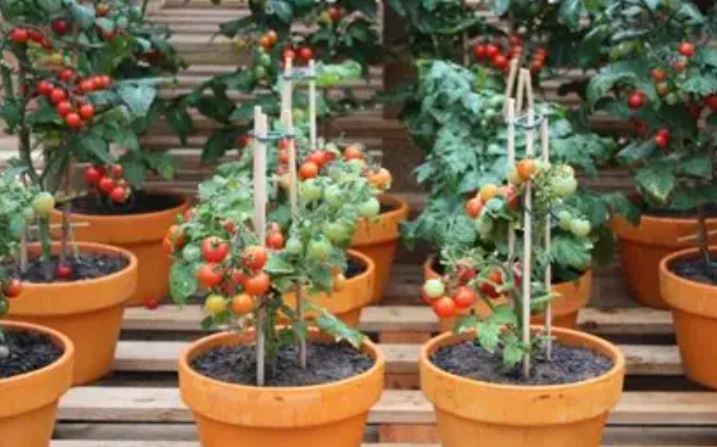
Proper planting technique sets the foundation for healthy root development and vigorous growth.
Starting from Seed vs. Transplants
Starting from seed is rewarding but requires 6–8 weeks of indoor growing. Many gardeners prefer buying healthy transplants from nurseries for a shorter growing time. If starting seeds, sow them ¼ inch deep in seed-starting trays 4–6 weeks before the last frost date.
The Deep Planting Technique
Tomatoes are unique—they can develop roots along their stems. When transplanting, bury ⅔ of the tomato stem. Plant seedlings deep enough so that the first set of true leaves is just above the soil surface. Roots will form along the buried stem, increasing stability and nutrient uptake.
Step-by-Step Planting
Fill your container with prepared potting mix, leaving 2 inches of space at the top. Water the soil lightly before planting. Gently remove the seedling from its container, teasing roots if root-bound. Place the plant deep in the hole, burying up to the lowest leaves. Firm the soil around the plant and water thoroughly.
Spacing in Containers
Plant one tomato plant per pot for best results. If using very large containers (e.g., half-barrels), you can plant two small determinate plants spaced 12–18 inches apart. Avoid overcrowding—each plant needs adequate space for roots and airflow.
Watering Container Tomatoes
Watering is the most critical and challenging aspect of container tomato care. Pots dry out faster than garden beds.
Why Containers Dry Out Faster
Containers have smaller soil volume and cannot hold as much moisture as garden beds. Roots are restricted and cannot spread in search of water. Hot decks, patios, and balconies cause faster drying, especially in dark plastic pots. Container tomatoes rely entirely on you for their water supply.
Watering Frequency by Season
In spring (establishment stage), water every 2–3 days as the plant begins to grow. In summer (flowering and fruiting stage), daily watering is usually needed—sometimes twice daily in heatwaves. In autumn, scale back to every 2–3 days as temperatures drop.
Golden rule: Water deeply until it drains from the bottom of the pot. This ensures the entire root zone is reached and avoids shallow roots that dry quickly.
Best Watering Practices
Always water in the morning to reduce fungal risk and maximize absorption throughout the day. Check soil moisture by sticking your finger 2–3 inches into the soil—if dry at that depth, it is time to water. Use mulch like straw or sugarcane to retain soil moisture and reduce evaporation. Group pots together to reduce wind exposure.
Signs of Watering Problems
Overwatering causes yellowing leaves (especially lower ones), wilting despite wet soil, and fungus or mildew near the base. Underwatering causes leaf curl, wilting in the afternoon, dry soil below the surface, and blossom end rot on fruit. Consistent moisture is essential to avoid blossom end rot and fruit cracking.
Fertilizing Container Tomatoes
Container tomatoes need regular feeding because nutrients leach out with frequent watering.
Understanding Nutrient Needs
Vegetative stage (weeks 1–4): Use a balanced liquid NPK fertilizer weekly to promote strong leaf, stem, and root development. Flowering to fruiting (weeks 5+): Switch to a high-potassium formula every 7–10 days to support fruit set, improve sweetness, and enhance color and yield.
Fertilizer Application Schedule
Add a slow-release fertilizer prior to potting up your plant. Supplement with soluble fertilizer through the season. A balanced fertilizer with an NPK ratio of 5-10-10 or 10-10-20 works well for bucket-grown tomatoes. Organic options like fish emulsion, seaweed extract, or compost tea are also excellent.
Fertilizer schedule for container tomatoes:
- At planting: Mix slow-release fertilizer into potting mix
- Weeks 1–4: Balanced liquid fertilizer weekly (e.g., 10-10-10)
- Weeks 5+: High-potassium fertilizer every 7–10 days (e.g., 5-10-15)
- Throughout: Compost tea or seaweed extract as supplemental feed
Organic Fertilizer Options
Fish emulsion provides balanced nutrition and is gentle on plants. Seaweed extract supplies trace elements and growth hormones. Compost tea boosts beneficial microorganisms. Worm castings added to the soil mix provide slow-release nutrients. Organic options are excellent for chemical-free gardening.
Preventing Nutrient Deficiencies
Nutrients in pots leach faster than in garden beds—feed consistently to avoid deficiencies. Calcium deficiency causes blossom end rot; maintain even moisture and use calcium-rich fertilizers. Magnesium deficiency shows as yellowing between leaf veins; Epsom salt foliar spray can help.
Supporting Container Tomato Plants
Tomatoes need support to remain upright and prevent branches from breaking under fruit weight.
Staking
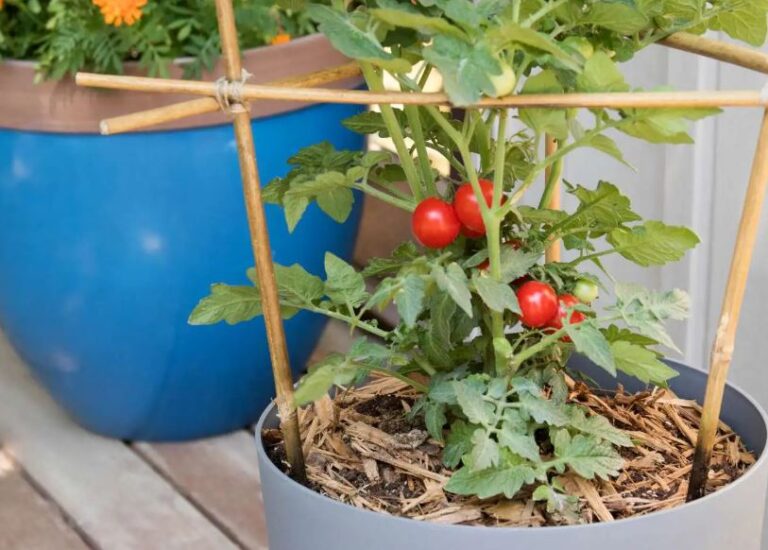
Insert stakes at planting time to avoid disturbing roots later. Use bamboo poles, wooden stakes, or metal T-stakes. Tie the main stem to the stake as it grows, using soft ties or strips of cloth. Staked plants need regular tying throughout the season. This method works well for small spaces.
Caging
Tomato cages are popular for containers. Choose cages that fit your pot size—small cages for determinate varieties, larger cages for indeterminates. Place the cage at planting time. Cages require less maintenance than staking and work well for sprawling plants. Fabric grow bags can accommodate cages easily.
Support method comparison:
- Staking: Best for small spaces; needs regular tying; good air circulation
- Caging: Less maintenance; good for sprawling plants; larger footprint
- Trellising: Efficient for multiple plants; good air flow
- String method: Space-saving; used in greenhouses; allows training vertically
Trellising for Multiple Plants
If growing multiple container tomatoes, consider a trellis system. Install a wire trellis or fan in the pot before planting. Train vines upward as they grow. This method saves space and improves air circulation. It works particularly well for indeterminate varieties.
When to Install Support
Install supports at planting time—never after roots have established. This prevents root damage and ensures the plant grows with proper support from the start. For indeterminate varieties, use tall supports (6 feet or more) to accommodate continuous growth.
Sunlight and Location Requirements
Tomatoes are sun lovers and need adequate light for optimal growth and flavor.
How Much Sun Do Container Tomatoes Need?
Tomato plants need 6 to 8 hours of direct sunlight every day. More sunlight means more sugar production, resulting in sweeter, more flavorful fruits. In northern regions, aim for 8–10 hours. In hot climates, morning sun with afternoon shade prevents heat stress.
Finding the Best Location
Place containers in a sunny spot—balconies, patios, decks, or rooftops that receive full sun. South-facing locations typically provide the best sun exposure. Observe your space throughout the day to identify areas with the most direct sunlight. Avoid spots shaded by trees, buildings, or structures.
Managing Heat Stress
In hot climates, afternoon shade can prevent blossom drop and sunscald. Move containers to a slightly shaded spot during the hottest part of the day. Use light-colored containers to reduce heat absorption. Group pots together to create a microclimate that moderates temperature.
Container Mobility Advantage
One of the greatest advantages of container growing is mobility. Move containers to chase sunlight as the season changes. In spring, position pots for maximum warmth. In summer, provide afternoon shade. In fall, move pots to extend the growing season.
Ongoing Container Tomato Care
Regular maintenance keeps your container tomatoes healthy and productive throughout the season.
Pruning Container Tomatoes
Remove lower leaves to increase airflow and reduce fungal risk. For determinate varieties, minimal pruning is needed—remove only dead or diseased leaves. For indeterminate varieties, remove suckers (side shoots) to direct energy into fruit production. Prune regularly throughout the season.
Mulching
Apply a 2–3 inch layer of mulch on top of the soil to retain moisture and reduce evaporation. Use straw, sugarcane mulch, or shredded leaves. Mulch also keeps soil cool in hot weather and prevents weed growth. Keep mulch 2–3 inches away from the stem to prevent rot.
Pest Management
Check for pests like aphids, caterpillars, and whiteflies weekly, especially under leaves. Elevated containers reduce some pest problems but regular monitoring is essential. Use insecticidal soap, neem oil, or introduce beneficial insects for organic control.
Harvesting
Harvest tomatoes when they reach full color and are slightly soft to the touch. Regular harvesting encourages the plant to continue producing fruit. Use clean pruners or scissors to cut fruits from the vine. Harvest in the morning when fruits are cool and firm.
Frequently Asked Questions About Container Tomatoes
1. What size container do I need for one tomato plant?
For cherry or dwarf patio types, use a pot at least 30–35 cm diameter and 30 cm deep. For medium determinate tomatoes like Roma, use 35–40 cm wide and 35–40 cm deep. For indeterminate vining tomatoes, use 40–50 cm wide and 45–60 cm deep. A 5-gallon container is the absolute minimum; 10–15 gallons is better for large varieties.
2. Can I grow tomatoes in a 5-gallon bucket?
Yes, a 5-gallon bucket can grow one tomato plant, but it is the minimum size. Drill several drainage holes in the bottom. Use a high-quality potting mix, not garden soil. Choose compact determinate or dwarf varieties for best results. Water daily in hot weather and feed regularly.
3. How often should I water tomatoes in containers?
Water container tomatoes daily during warm weather and fruiting. In spring, water every 2–3 days. In summer heatwaves, water may be needed twice daily. Always check soil moisture by feeling 2–3 inches deep—water only when dry at that depth. Water deeply until it drains from the bottom.
4. Can I use garden soil in containers for tomatoes?
No, garden soil is not suitable for containers. It compacts, blocks air movement, and prevents water from reaching the root zone. Garden soil may also harbor diseases and pests. Always use a premium potting mix formulated for vegetables or containers.
5. What are the best tomato varieties for containers?
The best container varieties are compact determinate or dwarf types. Recommended varieties include ‘Celebrity’, ‘Bush Early Girl’, ‘Patio’, ‘Tiny Tim’, ‘Red Robin’, and ‘Roma VF’. Cherry tomatoes like ‘Sweet Million’ and ‘Tumbling Tom’ also perform well. Avoid large beefsteak varieties in small containers.
6. Do container tomatoes need different fertilizer than garden tomatoes?
Container tomatoes need more frequent fertilization because nutrients leach out with frequent watering. Use a balanced liquid fertilizer weekly during vegetative growth. Switch to a high-potassium formula every 7–10 days during flowering and fruiting. Add slow-release fertilizer at planting time.
Quick Reference Tables
Table 1: Container Size Guidelines by Tomato Type
| Tomato Type | Minimum Container Size | Recommended Size | Pot Diameter | Pot Depth |
|---|---|---|---|---|
| Cherry/Dwarf Patio | 5 gallons | 5–7 gallons | 30–35 cm | 30 cm |
| Determinate (e.g., Roma) | 5 gallons | 7–10 gallons | 35–40 cm | 35–40 cm |
| Indeterminate (vining) | 10 gallons | 10–15 gallons | 40–50 cm | 45–60 cm |
| Large Indeterminate | 15 gallons | 20+ gallons | 50+ cm | 50+ cm |
Table 2: Recommended Container Tomato Varieties
| Variety | Type | Plant Height | Fruit Size | Best For |
|---|---|---|---|---|
| ‘Celebrity’ | Semi-determinate | 3–4 ft | Medium-large | Slicing, all-purpose |
| ‘Bush Early Girl’ | Determinate | 2½–3 ft | 3–4 in | Early harvest, slicing |
| ‘Patio’ | Dwarf determinate | 2 ft | 3–4 in | Small spaces, containers |
| ‘Tiny Tim’ | Dwarf | 12–18 in | Cherry | Windowsills, very small pots |
| ‘Red Robin’ | Dwarf | 12–18 in | Cherry | Containers, hanging baskets |
| ‘Roma VF’ | Determinate | 3–4 ft | Plum | Sauces, canning |
| ‘Tumbling Tom’ | Trailing dwarf | 12–18 in | Cherry | Hanging baskets |
| ‘Sweet Million’ | Indeterminate | 4–6 ft | Cherry | Continuous harvest, snacking |
Final Verdict: Growing Tomatoes in Containers
Growing tomatoes in containers is accessible, rewarding, and productive when you follow the right techniques. Start with the right container—at least 12–18 inches deep with drainage holes. Choose compact determinate or dwarf varieties suited to pots. Use a premium potting mix, never garden soil. Plant deep, burying two-thirds of the stem for strong roots. Water daily during fruiting and feed weekly with balanced fertilizer. Provide 6–8 hours of full sun and install support at planting time.
The extra care container tomatoes require is rewarded with healthier plants, fewer disease problems, and a bountiful harvest of sweet, flavorful fruit. Whether you have a sunny balcony, a small patio, or a rooftop garden, container tomatoes bring the joy of homegrown produce within reach. Start with a few plants, learn from each season, and soon you will be enjoying the unmatched taste of vine-ripened tomatoes grown in your own containers.

- How to Grow Microgreens Without Soil Indoors: Easy Home Method - October 5, 2026
- Microgreens vs. Sprouts: Key Differences, Nutrition, Safety, and Which One to Eat - October 5, 2026
- 10 Best Garden Tools For Weed Removal 2027 - October 3, 2026