If you’ve ever driven along the Trans-Canada Highway or wandered through a meadow in Ontario, you’ve almost certainly seen them. Fields of white and yellow daisies swaying in the breeze. It looks as Canadian as maple syrup and hockey, right?
Well, I’m here to tell you that things aren’t always what they seem. As a botanist who has spent years studying plant ecosystems across North America, I’ve had to break this news to a lot of surprised gardeners and nature lovers.
The short answer: no, the classic white daisy you see everywhere is not native to Canada.
Most of those iconic roadside flowers came from Europe. But we do have native daisies of our own. They’re smaller, shyer, and easy to walk right past. So let’s sort out what’s growing in your yard, whether you live in Ontario, Alberta, BC or the Maritimes, and whether you should keep it or pull it.
The Great Daisy Deception: Is the Daisy in Ontario Native?
When most people think of a “daisy,” they picture a bright yellow centre ringed with white petals. The plant that fills so many Canadian ditches and meadows is Leucanthemum vulgare, the oxeye daisy.
Here’s the hard truth: the oxeye daisy is not native to Canada. It comes from Europe and Asia, and it has been in North America since at least the 1800s. It likely arrived mixed in with crop seed, or with settlers who missed the look of home and planted it on purpose.
So if you’ve been searching “is oxeye daisy native to Ontario?”, the answer is no. And if you’re wondering whether daisies are common in Ontario, they are. Most of the common ones are the imported kind. Oxeye is naturalized here, which means it grows and spreads on its own without anyone’s help.
It looks innocent. But this flower is a bit of a bully.
Is Oxeye Daisy Invasive? It Depends Where You Live
You might look at a field of oxeye and think, “How can something so beautiful be bad?” I totally get that. But the rules change depending on the province:
- Ontario: oxeye daisy isn’t on the province’s noxious weed list, but it’s still non-native and it spreads into meadows and disturbed ground. “Not regulated” doesn’t mean “harmless.”
- Alberta: oxeye daisy is a noxious weed under the Weed Control Act. If you searched “oxeye daisy Alberta invasive,” this is why.
- British Columbia: it’s designated a regional noxious weed, and it’s a particular concern in the Okanagan, Cariboo and Thompson areas.
- Yukon: it’s still sold as a garden plant there, and it has turned up around Whitehorse, Dawson and Watson Lake and along the Alaska Highway.
Why the Oxeye Daisy Is Called a “Noxious Weed”
If you’ve ever typed “which daisy is invasive” into a search bar, here’s why the answer is oxeye:
- The reproduction rate: a single oxeye plant can produce up to 26,000 seeds. That’s an army of daisies ready to march across your lawn.
- The stubborn seeds: they don’t die off after a year. Depending on the source, they can stay viable in the soil anywhere from a few years to about 20, waiting for the right moment.
- The underground network: oxeye also spreads by creeping roots called rhizomes. Pull the flower and the plant can still pop up feet away from the original.
- The economic impact: this isn’t just about looks. Out west, oxeye crowds out pasture grass, and cattle won’t eat it. That costs farmers real money in lost forage and hay.
Are Any Daisies Native to Canada? (Yes! Meet the Fleabanes)
Now, I don’t want to leave you feeling like every daisy is a foreign villain. That isn’t true.
The daisy family (Asteraceae) is one of the largest families of flowering plants in the world. It includes sunflowers, asters and lettuce. So while oxeye is an import, we have plenty of native “daisy-type” flowers that fit right into the local ecosystem.
If you want a true native Canadian daisy, start with the fleabanes (genus Erigeron).
The Native Hero: Philadelphia Fleabane
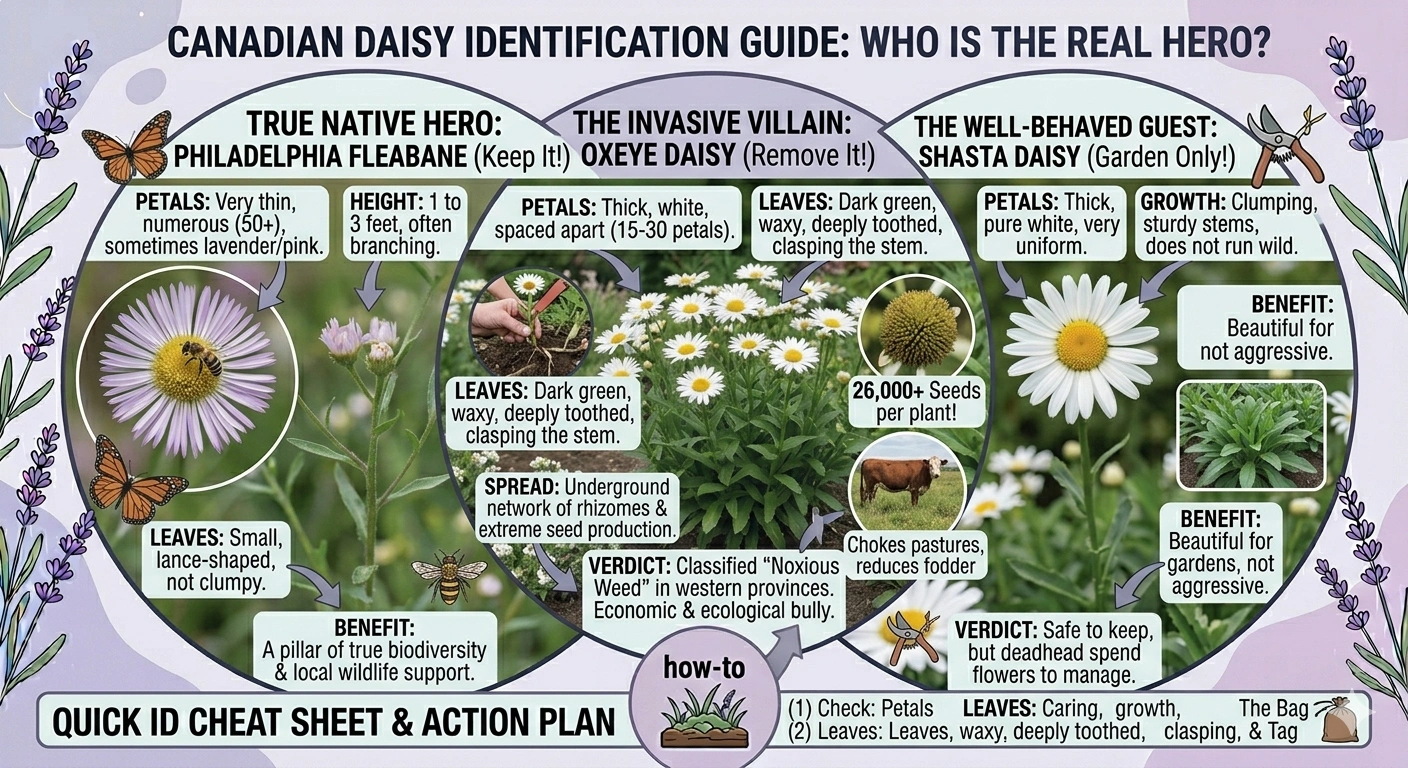
Unlike the thick, sturdy stem of oxeye, the native Philadelphia fleabane (Erigeron philadelphicus) is delicate. It has many thin petals, often 100 or more, and the flowers are noticeably smaller. If you’ve asked “is Philadelphia fleabane native to Ontario, Canada?”, yes, it is.
- Status: native across most of Canada, including Ontario, New Brunswick, Nova Scotia and Newfoundland and Labrador.
- Eco-benefits: bees, flies and butterflies visit it heavily in late spring and early summer. Planting it helps rebuild the local food chain.
- Appearance: a “wild” daisy look, often with pink or lavender-tinged petals.
If you’re hunting for a list of native daisies in Ontario, or asking whether daisy fleabane is native to Ontario, there are two more to know. Daisy fleabane (Erigeron annuus) is native to eastern North America and shows up in Ontario meadows and along roadsides. It’s taller and branchier, with lots of small white flowers on one plant. Its close cousin, lesser daisy fleabane (Erigeron strigosus), looks similar with narrower leaves.
There’s also a rare variety worth knowing about: Provancher’s fleabane (Erigeron philadelphicus var. provancheri). It grows on limestone shorelines and has been recorded around the Bruce Peninsula and near Manitoulin Island in Ontario, plus parts of Quebec. Botanists are still working out exactly how to classify it, so don’t expect to find it in your backyard.
Fleabane vs. Aster vs. Mountain Daisy: Sorting Out the Look-Alikes
This is where most people get tangled up, so here’s the quick version:
- Fleabane: many hair-thin petals, small flowers, blooming late spring through summer.
- Asters: they bloom late summer into fall, and many are purple, blue or lavender. If you’ve wondered whether Michaelmas daisies are native to Ontario, the wild asters that carry that name are. Many of the garden-center versions are cultivated types.
- Mountain daisies: mostly western, and mostly in the fleabane group.
Lavender daisy-like flowers? If you’re seeing lavender or pink “daisies” in Canada, it’s almost never oxeye. Oxeye is white. Lavender or pink petals usually mean a fleabane or an aster.
Tiny yellow daisies with white sap? A quick test: snap a stem. If it bleeds milky white sap, it isn’t a fleabane, because fleabanes don’t have milky sap. You’re probably looking at a dandelion relative such as a sow-thistle or a hawkweed.
Native Daisies in Alberta, BC and the Rest of Canada
Alberta: provincial invasive plant guidance says there are no native white-flowered daisies in Alberta. So a big white daisy in an Alberta field is almost certainly oxeye or scentless chamomile, and both are noxious. Alberta does have native fleabanes, but they lean toward violet and lilac rather than white.
British Columbia and the Okanagan: asking “are white daisies native to the Okanagan area?” gets the same answer. The common white one is oxeye, which is a documented concern in the region. The native option is the showy daisy (Erigeron speciosus), a BC native with purple, pink or sometimes white petals around a yellow centre. It flowers all summer and pollinators love it. If you’re around Merritt or the Okanagan, ask a local native plant nursery about it.
Yukon and the north: oxeye has followed the roads and gardens north, so a white daisy in Whitehorse or Dawson is worth a closer look before you decide it belongs.
Atlantic Canada: Philadelphia fleabane is native in New Brunswick, Nova Scotia and Newfoundland and Labrador, while oxeye is widespread along roadsides in the region. Same look-alike problem, same fix: check the petals and the leaves.
Manitoba and the Prairies: the same rule of thumb applies. If you’re not sure, your local weed authority or native plant society can confirm what’s growing.
The “Good” Foreigner: The Shasta Daisy
Before you go scorched earth on your garden, we need to talk about the Shasta daisy (Leucanthemum x superbum).
This is the big, beautiful white flower you buy at the garden centre. So, are Shasta daisies native to Ontario? No. They’re a garden hybrid, developed by Luther Burbank in the late 1800s, and oxeye is part of the family tree.
- The oxeye is the scrappy, aggressive one on the roadside.
- The Shasta is the cultivated cousin that stays in your flower bed.
Is Shasta daisy invasive in Ontario? Not the way oxeye is. Shastas grow in tidy clumps and don’t run by rhizomes. But there’s a catch: they can cross with oxeye, and invasive species councils in places like the Yukon say their invasiveness is still being studied. My advice is to grow them if you love them, deadhead them so they don’t seed around, and keep them out of wildflower meadows.
How to Identify Which Daisy You Have
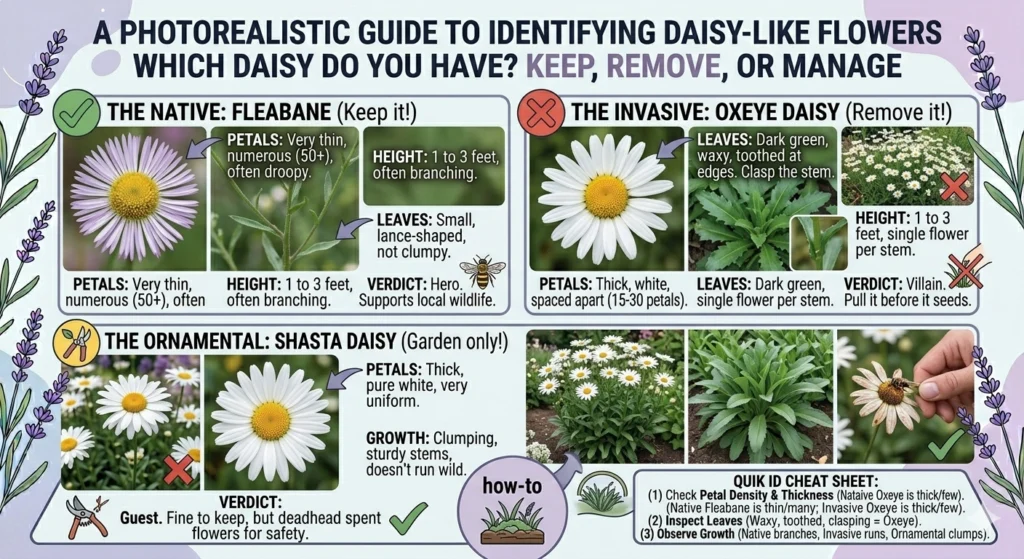
I often get emails from readers asking, “Should I pull this?” Here’s a cheat sheet you can use tomorrow morning in your yard.
| Native fleabane | Oxeye daisy | Shasta daisy | |
|---|---|---|---|
| Status in Canada | Native | Introduced from Europe | Garden hybrid |
| Petals | Very thin, numerous (50 to 150+), often droopy, sometimes pink or lavender | Thick, white, spaced apart (about 15 to 30), notched at the tip | Thick, pure white, very uniform |
| Flower size | Small | About 5 cm across | Larger than oxeye |
| Growth | 1 to 3 feet, branching, many small flowers | 1 to 3 feet, usually one flower per stem, spreads by roots | Tidy clumps, doesn’t usually run wild |
| Leaves | Undivided, often hairy stems, may clasp the stem | Dark green, toothed or lobed, clasping the stem | Larger, less lobed |
| Verdict | Hero. Keep it. Supports local wildlife. | Villain. Pull it before it seeds. | Guest. Fine in the garden. Deadhead it. |
What Should You Do If You Find Oxeye Daisies?
If you’ve identified oxeye on your property, don’t just toss it on the compost pile. You might be making the problem worse. Here’s the battle plan I recommend:
1. The Early Bird Strategy
Catch it in spring. The rosette (the low circle of leaves) pulls out easiest when the soil is damp, so get as much root as you can. If you let it flower, you have about 10 days before the seeds can become viable.
2. The “Bag and Tag” Method
If the plant has flowers or seed heads, do not compost them. Home compost rarely gets hot enough to kill oxeye seeds. Bag the flower heads and put them in the garbage. The Yukon Invasive Species Council even suggests leaving the bagged plants in the sun in a clear bag to cook the roots and seeds.
3. Watch for “Wildflower” Mixes
I see this mistake all the time. You buy a “Wildflower Mix for Canada” at the big-box store, spread it around, and suddenly you have oxeye everywhere. Always read the scientific names on the seed packet. If it says Leucanthemum vulgare, put it back on the shelf.
4. Be Patient
Because the roots can resprout, one pull rarely finishes the job. With an established patch, expect to keep at it for a few seasons.
What to Plant Instead of Oxeye Daisy
Pulling oxeye leaves a gap, and bare soil invites weeds back in. Here are better things to put there:
- Philadelphia fleabane or daisy fleabane: native, airy and easy, and great for pollinators in eastern Canada.
- Native asters, such as New England aster: they bloom in late summer and fall and keep the pollinator buffet open after the fleabane fades.
- Showy daisy (BC and the interior west): purple, pink or white, and drought tolerant.
- Other non-invasive picks in BC: BC’s invasive species council also suggests cutleaf daisy, smooth fleabane and arnica.
- Shasta daisy: if you want the classic big white flower, it’s the safer choice for a flower bed.
Buy from a native plant nursery when you can, and check the Latin name on the tag or seed packet, just like you would for wildflower mixes.
A Note on “Naturalized” vs. “Native”
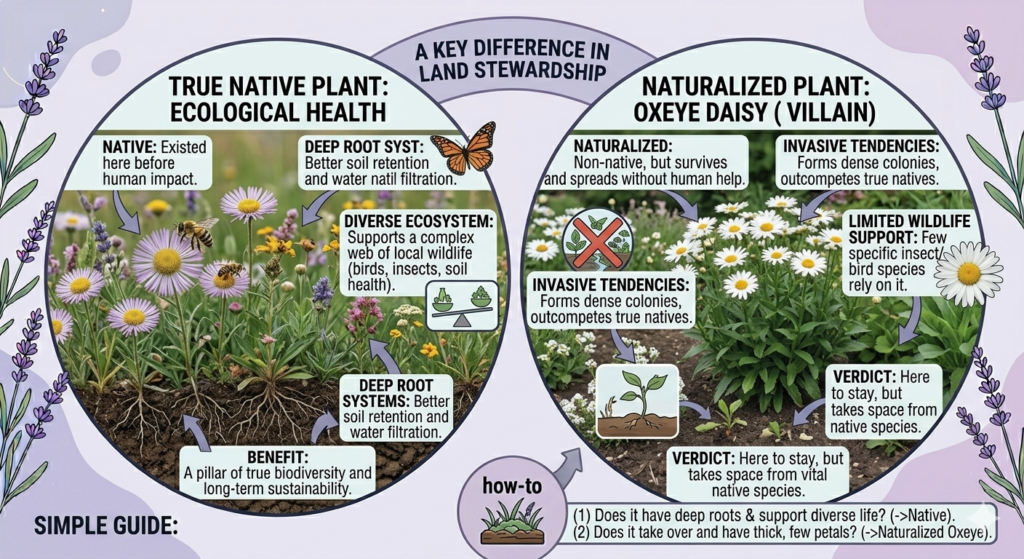
You’ll hear the word “naturalized” a lot. It’s a tricky one.
A plant is naturalized when it isn’t native, but it has adapted to live here without any help from us. Oxeye is absolutely naturalized. You can’t get rid of it entirely, and it’s here to stay.
But naturalized does not mean good. Naturalized plants often take space from our true natives. As stewards of the land, we should aim for ecological health, not just “green.”
One more thing, since people search for it: oxeye only arrived in the 1800s, so it has no long history in Canada. If you’re curious about how Indigenous communities have used native daisy relatives, the best source is local First Nations knowledge-keepers, not a general website like this one.
Quick Answers About Daisies in Canada
Is daisy native to Canada?
The classic white one, no. Native fleabanes and asters are.
Do daisies grow in Canada?
Yes, from coast to coast. But the most common ones in fields and along roads are introduced.
Are daisies native to North America?
Some are. Fleabanes and asters are native. Oxeye and Shasta aren’t.
Are daisies always white?
No. Fleabanes and asters come in lavender, pink, purple and blue, and the centre is usually yellow.
Are daisies perennials in Canada?
Oxeye and Shasta are. Daisy fleabane is an annual, and Philadelphia fleabane is short-lived.
Are Michaelmas daisies native to Ontario?
The wild asters that go by that name are. Many garden-center cultivars are not.
Which daisy is invasive?
Oxeye daisy, and in the west, scentless chamomile too. Both are listed as noxious in Alberta.
Final Thoughts: Loving Your Landscape
Don’t feel bad if you’ve been loving oxeye your whole life. It’s beautiful, and it smells like summer. But now that you know the truth, I challenge you to look closer.
Next time you’re hiking in British Columbia or driving through rural Quebec or Ontario, see if you can spot the difference. Look for the scraggly fleabane, the shy native wallflower that is quietly working to feed the bees.
If you have oxeye in your yard, have fun pulling it out. It’s surprisingly therapeutic. And if you want to plant daisies, buy a Shasta for your ornamental garden or seek out a nursery that sells native Erigeron species. Your local pollinators will thank you.
Have you spotted oxeye daisies taking over your area? Or do you have a patch of native fleabane? Let me know in the comments below.

- How to Grow Microgreens Without Soil Indoors: Easy Home Method - October 5, 2026
- Microgreens vs. Sprouts: Key Differences, Nutrition, Safety, and Which One to Eat - October 5, 2026
- 10 Best Garden Tools For Weed Removal 2027 - October 3, 2026