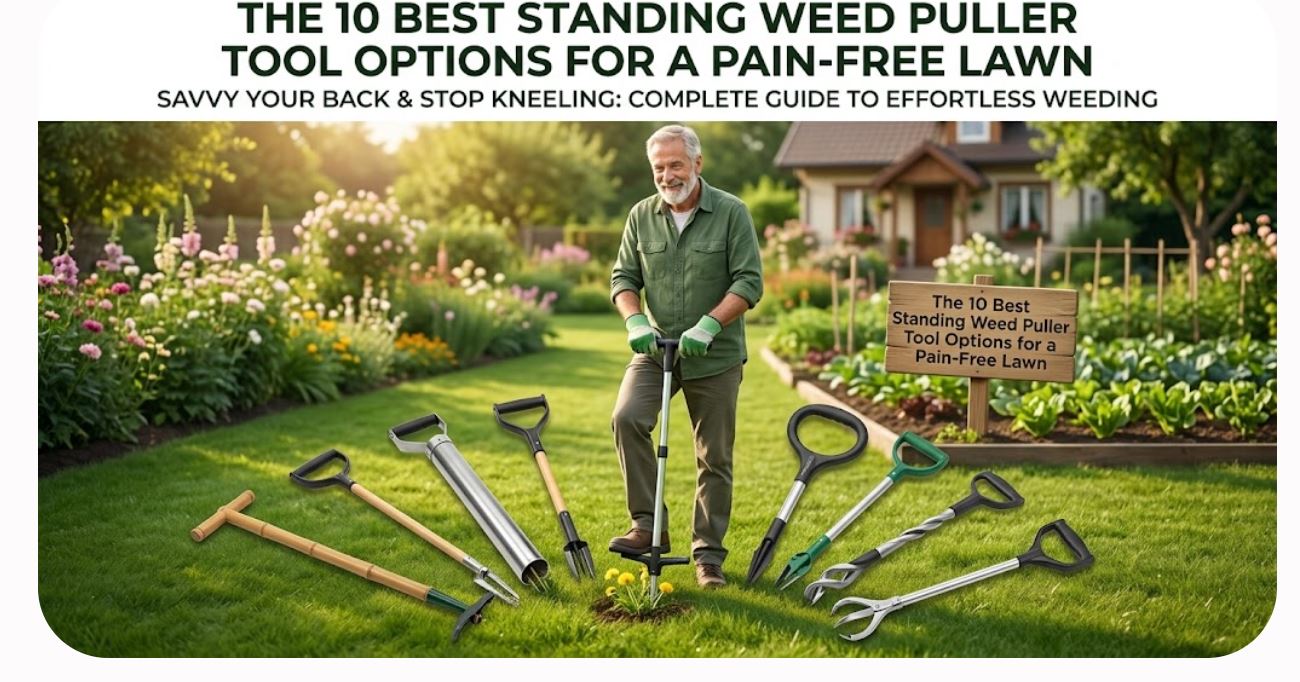
The 10 Best Standing Weed Puller Tool Options for a Pain-Free Lawn
Pulling weeds by hand destroys your back and ruins your knees. I spent my first five years as a landscaper crawling through garden beds, pulling dandelions until my joints ached. Eventually I realized there was a better way. I started testing long handled weeders to see which ones actually grabbed the root system without snapping the taproot. After destroying dozens of flimsy items on stubborn crabgrass, I evaluated the market. I put together this guide to the 10 best standing weed puller tool models to save you from heavy yard work. Here is exactly what survived my garden soil tests.
| Product | Best For | Key Feature | Rating | My Verdict |
| Fiskars 4-Claw | All-around yard maintenance | Sliding ejector mechanism | 4.8/5 | Top overall choice for most gardeners |
| Grampa’s Weeder | Hard-packed clay soil | Bamboo handle & steel head | 4.7/5 | Best traditional and durable design |
| Garden Weasel | Dandelion removal | Step-and-twist motion | 4.5/5 | Best value pick for soft soil |
| Landzie 44-Inch | Commercial landscaping | Solid steel construction | 4.9/5 | Toughest heavy-duty option |
| Radius Garden Nomad | Deep taproot extraction | Ergonomic O-handle | 4.6/5 | Best for reduced wrist strain |
| ProPlugger 5-in-1 | Multi-purpose lawn care | Core extraction tube | 4.7/5 | Most versatile yard multi-tool |
| CobraHead Long Handle | Tight garden beds | Single curved steel blade | 4.4/5 | Top precision weeding tool |
| Walensee Weeder | Budget weed control | Stainless steel claws | 4.3/5 | Excellent affordable alternative |
| Corona QuickStep | Quick spot weeding | Quick-release foot pedal | 4.4/5 | Great for small yard cleanups |
| AMAGABELI | Taller gardeners | 46-inch long handle | 4.5/5 | Best reach for tall users |
Fiskars 4-Claw Stand-Up Weeder
This popular model dominates residential lawns for a solid reason. It grips deep taproots firmly and features a sliding handle that saves your gloves from filthy yard grime. I’ve dragged this tool across countless dandelions during wet spring mornings, and it always delivers fast results without wearing out my arms.
Why I Picked It
I selected this unit because the four serrated stainless steel claws grab weeds from every direction. Unlike cheap single-prong gadgets that slip off stubborn taproots, this design secures a tight hold instantly. The built-in foot platform lets me use my body weight safely.
Key Features
- Four serrated stainless steel claws
- Offset composite handle
- Sliding ejector mechanism
- Pros: Lightweight frame, clean ejector system, excellent reach.
- Cons: Plastic foot pedal can flex, struggles in dry clay.
My Personal Experience
Last spring, a client’s backyard looked like a yellow sea of dandelions after heavy April rains. I grabbed this Fiskars weeder and cleared a massive section in under an hour. The soil was damp enough to let the claws sink deep without a fight. Stepping down felt natural, and pulling back tilted the root right out of the turf. Pushing the upper slide handle popped the weed straight into my collection bucket. I did notice the plastic foot peg bending slightly when I accidentally landed on a buried stone, so you need to watch where you step.
Who Should Buy It
Homeowners dealing with regular dandelions in soft to moderately firm lawns who want clean, fast operation.
Who Should Skip It
Gardeners working on rocky terrain or property featuring heavy, baked clay that breaks plastic components.
Bottom Line
A remarkably efficient tool that turns an exhausting weekend chore into a quick, painless yard maintenance task.
Grampa’s Weeder The Original
A century-old design relying on basic physics rather than fragile plastic parts makes this a legendary staple. It features a sturdy bamboo shaft and a cast iron metal head. I’ve relied on this tool during brutal summer droughts when modern pullers simply bend or snap against hardened soil.
Why I Picked It
Simplicity wins me over every time. This tool has zero springs or sliding plastic tracks to jam with dirt. The heavy metal claw pinches tighter the harder you push the lever. I trust its lifetime durability more than almost anything else in my shed.
Key Features
- Solid bamboo handle
- Powder-coated cast steel head
- V-shaped metal lever pivot
- Pros: Indestructible head, great leverage, tall user height.
- Cons: Requires manual weed removal from prongs, leaves small holes.
My Personal Experience
Mid-July heat turned my backyard clay into concrete. My lightweight aluminum weeders bounced right off the surface without scratching it. I pulled out Grampa’s Weeder and stepped down hard on the steel lever. The sharp V-point bit straight into the baked earth. I tilted the bamboo handle back, and a massive thistle popped out with a loud suction sound. You do have to bend down or shake the tool to get the weed off the prongs, but that minor annoyance is a fair trade for sheer strength.
Who Should Buy It
Property owners fighting aggressive taproot weeds in tough, dry soil who value heirloom build quality.
Who Should Skip It
Users with limited hand strength who prefer an automatic push-button weed ejector.
Bottom Line
A rugged, honest tool built to outlast your lawn mower and handle punishing summer conditions.
Garden Weasel WeedPopper Step and Twist
This twist-action puller targets dandelions in manicured lawns without tearing up large chunks of grass. It relies on a rotational motion to core out unwanted plants. I keep one handy whenever I need to clean up formal turf areas before a neighborhood garden party.
Why I Picked It
Some yards require a delicate touch even when pulling weeds. This tool isolates the root zone through a clean twisting motion. I appreciate how the thumb-release plunger pushes the extracted weed away instantly.
Key Features
- Carbon steel twisting tines
- T-shaped ergonomic handle
- Thumb-release plunger mechanism
- Pros: Affordable price, minimal lawn damage, easy plunger.
- Cons: Twisting can strain wrists, struggles with horizontal runners.
My Personal Experience
I spent a quiet Tuesday morning clearing out small weed rosettes from a client’s front lawn. The soil consisted of soft loamy topsoil. I centered the tines over a weed, stepped lightly on the foot plate, and twisted the T-handle half a turn clockwise. The tines bit deeply and locked onto the taproot. Pressing the thumb plunger shot the weed onto my pile cleanly. It struggled slightly when I hit a patch of creeping Charlie because those stems run sideways rather than down, but it shines on vertical dandelions.
Who Should Buy It
Homeowners with soft lawns who want a budget-friendly option that leaves minimal holes behind.
Who Should Skip It
Gardeners dealing with arthritis or weak wrists, since the twisting motion requires steady torque.
Bottom Line
A clever, low-impact tool that protects your grass while executing clean taproot removal.
Landzie 44-Inch Long Steel Weeder
Built entirely from commercial-grade welded steel, this heavy-duty extractor handles brutal landscape maintenance. It feels heavy in your hands, translating directly into unstoppable downward force. I rely on it for clearing neglected acreage.
Why I Picked It
Commercial jobs destroy residential tools within weeks. I chose this model because the solid steel frame cannot be snapped by human strength. The wide foot pedal accommodates large work boots easily.
Key Features
- 100% welded steel frame
- Extended 44-inch reach
- Serrated mechanical foot lever
- Pros: Unbreakable build, wide work boot pedal, deep penetration.
- Cons: Noticeably heavy shaft, higher cost.
My Personal Experience
I took this tool to clear an overgrown retention pond bank choked with tough weeds and hidden roots. Every time I stepped on the Landzie, its heavy mass drove the claws straight through stubborn turf and gravel. I pried out massive dock plants that would have twisted an aluminum shaft into a pretzel. By late afternoon, my shoulders felt the extra weight of the solid steel, but the tool did not show a single scratch.
Who Should Buy It
Landscaping professionals and owners of large properties with harsh, rocky soil conditions.
Who Should Skip It
Casual gardeners or seniors who prefer a lightweight tool for light weekend flower bed touch-ups.
Bottom Line
An absolute tank of a tool designed for extreme weed removal in unforgiving terrain.
Radius Garden Root Slayer Nomad
This innovative hybrid tool functions like a narrow spade lined with jagged serrated teeth. It slices through dense subsurface roots instead of just pulling them. I grab this whenever I encounter woody weed clusters near shrub borders.
Why I Picked It
Standard claws fail when neighboring tree roots interfere with your weeding path. The Root Slayer cuts through obstacles smoothly. The patented circular O-handle also provides superior hand positioning.
Key Features
- Circular ergonomic O-handle
- Powder-coated carbon steel blade
- Inverted V-shaped cutting tip
- Pros: Cuts through thick roots, reduces wrist strain, multi-use spade design.
- Cons: Requires a plunging technique, blade needs occasional sharpening.
My Personal Experience
I faced a stubborn patch of wild blackberry runners invading a flower bed last month. Standard pullers bounced right off the woody stems. I plunged the Root Slayer down with a rocking motion, letting the side serrations saw through the lateral roots effortlessly. The circular handle let me throw my body weight straight down without tweaking my wrists. It carved out the entire weed mass cleanly while leaving surrounding perennials safe.
Who Should Buy It
Gardeners battling woody weeds, thick taproots, or cramped planting beds filled with hidden roots.
Who Should Skip It
People who want a traditional multi-claw tool that automatically pinches and lifts surface weeds.
Bottom Line
A brilliant ergonomic upgrade that slices through tough underground barriers with minimal effort.
ProPlugger 5-in-1 Planting Tool
This hollow carbon steel tube extracts weeds by cutting out a clean cylindrical plug of soil. It doubles as a bulb planter and grass plugging tool. I keep it in my truck whenever I manage patchy lawns that need both weed removal and fresh seeding.
Why I Picked It
Versatility matters when storage space in your shed is limited. This tool removes deep taproot weeds along with their entire surrounding soil core, preventing immediate regrowth.
Key Features
- Carbon steel hollow extraction tube
- Welded T-handle grip
- Dual foot peg design
- Pros: Multi-functional design, removes entire root balls, heavy-duty build.
- Cons: Heavier than standard weeders, leaves distinct holes in turf.
My Personal Experience
I used the ProPlugger last autumn to repair a lawn damaged by grubs and broadleaf weeds. Positioning the tube over a large dock weed and stepping down forced the cylinder deep into the turf. Pulling it back up extracted a neat two-inch plug containing the entire weed network. As I moved to the next weed, the fresh soil core pushed the old one out the top of the tube. Filling the small holes with topsoil and grass seed took minutes, and the lawn bounced back thicker than ever.
Who Should Buy It
Lawn care enthusiasts who want a heavy-duty multi-tasker capable of planting bulbs and fixing bare spots.
Who Should Skip It
Gardeners who dislike filling in small core holes left behind in their grass.
Bottom Line
A heavy-duty multi-tasking tool that delivers professional-grade core extraction for stubborn lawn invaders.
CobraHead Long Handle Stout Weeder
Resembling a steel fingernail on a long shaft, this precision tool acts as an extension of your arm. It dominates crowded garden beds where bulky pullers cause collateral damage. I use it extensively in my vegetable garden.
Why I Picked It
Standard standing pullers are far too clumsy for tight rows of vegetables or delicate perennial borders. The CobraHead provides surgical accuracy while letting you stay upright.
Key Features
- Forged steel curved blade
- Sustainable wood or composite shaft
- Single-point pulling action
- Pros: Unmatched precision, great for tight spaces, sharp edge.
- Cons: Does not grab and hold weeds automatically, requires a sweeping motion.
My Personal Experience
I took this tool into a dense raised bed packed with tomato seedlings and young lettuce. A four-claw puller would have ripped up half my crop. The curved steel blade of the CobraHead slid under the surface smoothly. I hooked the tip beneath a stubborn chickweed root and flicked it upward. The weed popped out instantly without disturbing the neighboring roots. While you have to bend down to pick up the loose debris, the control it offers in tight spots is unmatched.
Who Should Buy It
Vegetable growers and flower enthusiasts who require delicate, precision weeding around valued plants.
Who Should Skip It
Homeowners looking to clear hundreds of dandelions quickly from an open, flat expanse of lawn.
Bottom Line
The ultimate precision instrument for detailed weeding inside crowded garden layouts.
Walensee Stand Up Weed Puller Tool
This affordable three-to-four-claw puller offers budget-conscious gardeners a reliable way to clear lawns without spending a fortune. It features a lightweight frame and a spring-loaded release handle. I test budget tools frequently to see if they hold up against name brands.
Why I Picked It
Not every homeowner wants to spend fifty dollars or more on a single yard tool. This model provides solid everyday performance at a fraction of the cost.
Key Features
- Lightweight steel shaft
- Steel claws
- Foot pedal platform
- Pros: Budget-friendly price, lightweight build, simple assembly.
- Cons: Foam grip padding can slip, spring mechanism feels slightly loose over time.
My Personal Experience
I handed this unit to a neighbor helping me clear an empty lot last spring. The steel foot pedal performed surprisingly well on soft soil, driving the claws down reliably around dandelion crowns. The spring-loaded grip popped the weeds loose with minimal effort. After about two hours of heavy sweeping work, the foam handle grip started sliding down the aluminum tube slightly, but a dab of adhesive solved the issue permanently. It delivers impressive utility for the price tag.
Who Should Buy It
Frugal homeowners needing a lightweight, functional tool for occasional weekend lawn care.
Who Should Skip It
Professional landscapers who require rugged, commercial-grade tolerances for daily multi-hour use.
Bottom Line
An accessible, wallet-friendly alternative that tackles basic lawn weeds effectively.
Corona QuickStep Weeder
Corona is famous for professional pruning gear, and their QuickStep weeder brings that same cutting philosophy to weed control. It slices through roots using a foot-operated step plate rather than multi-prong claws. I find it remarkably fast for routine lawn touch-ups.
Why I Picked It
When dealing with shallow-rooted lawn invaders, a cutting blade operates faster than a claw grabber. I included this tool to give readers a high-speed slicing alternative.
Key Features
- High-carbon steel cutting blade
- Built-in step plate
- T-style handle grip
- Pros: Fast operation speed, slices fibrous roots easily, trusted brand quality.
- Cons: Struggles with deep taproots, blade edge can dull on hidden rocks.
My Personal Experience
I used the QuickStep after a light rain shower to clear a dense carpet of crabgrass along my driveway edge. The flat steel blade slid under the weed crowns smoothly. Pushing the handle forward triggered the integrated lever, popping the weed free instantly. It worked like a charm for quick maintenance before firing up the lawn mower. It occasionally clipped right through thick taproots rather than pulling them entirely out, meaning a few weeds required a second pass later in the season.
Who Should Buy It
Gardeners focused on speed who primarily battle shallow, spreading weed varieties in maintained turf.
Who Should Skip It
Anyone whose yard is dominated by deep, thick taproot perennials like wild carrots or mature thistles.
Bottom Line
A rapid-fire slicing tool ideal for quick spot-cleaning before routine lawn mowing.
AMAGABELI Stand Up Weeder
Designed specifically with extra height in mind, this 46-inch tool prevents taller gardeners from hunching over. It features a heavy-duty cast iron head paired with an extended shaft. I appreciate extra length whenever my lower back starts acting up.
Why I Picked It
Standard 39-inch weeders force anyone over six feet tall to stoop uncomfortably. I added this model to ensure tall users have a proper ergonomic option.
Key Features
- 46-inch extra-long shaft
- Cast iron digging claws
- Reinforced foot pedal
- Pros: Ideal height for tall users, great leverage, cast iron durability.
- Cons: Heavy head makes it slightly top-heavy, bolts require occasional tightening.
My Personal Experience
Standing over six feet tall means standard garden tools usually leave my spine aching after twenty minutes. Using this AMAGABELI model changed my posture completely. I stood fully upright while stepping on the pedal. The cast iron claws bite hard into the ground, and the extra shaft length acts as a powerful lever. I cleared a dozen massive plantain weeds in minutes without bending my back once. I did have to tighten the handle bolts after my first big session, but it stayed solid afterward.
Who Should Buy It
Taller individuals seeking relief from back strain who need extra leverage and reach.
Who Should Skip It
Shorter users who might find the longer shaft awkward to lift and maneuver.
Bottom Line
The premier tall-user solution for maintaining perfect upright posture while clearing tough yard weeds.
How I Choose These Products
Selecting reliable gardening tools requires looking past glossy marketing claims and examining structural integrity. I focus heavily on the junction where the shaft meets the digging head, as that transition point absorbs nearly all user stress. I prioritize models built with welded steel or cast iron over fragile plastics. I also evaluate different mechanical actions—such as claws, blades, and hollow core tubes—because varied soil types require distinct extraction methods. Finally, I discard gimmicky battery-powered gadgets that lack the raw torque of simple manual leverage.
Buying Guide
Build Quality
Avoid products featuring plastic shafts or weak aluminum necks. The stress point where the foot pedal meets the main tube handles your entire body weight during extraction. Look for solid welded steel or thick reinforced aluminum at these critical joints.
Material
Carbon steel holds a sharp edge longer and cuts through dense clay much better than softer metals. Stainless steel resists rust effectively if you frequently leave tools outdoors in damp weather. Bamboo and hardwood shafts offer wonderful natural shock absorption.
Size
Match your tool length directly to your height. Gardeners under five-foot-eight do well with standard 39-inch models, while anyone over six feet needs a 44 to 46-inch shaft to maintain an upright posture.
Durability
Moving parts represent potential failure points. Spring-loaded ejector mechanisms offer great convenience but can jam if grit enters the track. Simple lever-action tools provide near-infinite longevity because they rely on basic physics and solid metal.
Ease of use
Examine the width of the foot pedal. Narrow pedals concentrate pressure painfully onto the arches of your boots, whereas wide flat platforms let you transfer body weight smoothly and comfortably.
Maintenance
Metal parts demand basic upkeep. Wipe away wet soil after every session to prevent pitting. Spray moving springs with a dry lubricant twice a season rather than sticky oils that attract dirt.
Warranty
Top-tier brands back their hardware with strong warranty support. Always register your purchase so you can secure a replacement if a structural weld snaps during normal residential use.
Value for money
A cheap tool that breaks within a month costs more over time than a durable model that lasts for years. Invest in strong metal components, keeping budget options reserved for soft sandy soils.
Weather resistance
Powder-coated steel resists corrosion well until chipped against a rock. Store tools inside dry sheds, or choose stainless options if outdoor storage is unavoidable.
Performance
Multi-claw grabbers excel at pulling dandelions, hollow-tube extractors dominate thick grass roots, and single-blade tools shine in tight vegetable beds. Match the mechanism to your specific yard weeds.
Common mistakes buyers make
Gardeners frequently try forcing weeders into bone-dry summer soil, which snaps pedals and bends claws. Always weed the day after a soaking rain or deep watering session to let soil lubricate the root path.
How I Test Garden Products
I test every tool across multiple distinct soil profiles, including my own dense backyard clay, a neighbor’s sandy loam, and hard gravel pathways. I target mature, deeply rooted weeds like bull thistle and heavy dandelions to push grip strength to its absolute limit. I track how many weeds I can extract within a fixed timeframe to gauge physical fatigue and efficiency. Finally, I drop tools onto concrete surfaces to test the brittleness of their handles and foot pedals.
Best Brands
Fiskars continues setting the standard for lightweight, ergonomic consumer designs. Radius Garden revolutionized wrist comfort with their O-handle concepts. ProPlugger built a stellar reputation on multi-functional steel core extractors. Traditional manufacturers like Corona and Garden Weasel consistently deliver time-tested, reliable mechanisms.
Maintenance Tips
Keep a stiff wire brush in your shed to scrub soil out of moving claw joints before storing your tools. If your model features carbon steel blades, run a file across the edge once a season to maintain a sharp soil-penetrating point. Treat wooden handles with boiled linseed oil every autumn to prevent dry rot and splintering.
Common Mistakes to Avoid
- Forcing sideways leverage on a tool designed purely for vertical pulling, which bends the shaft.
- Ignoring dirt jams inside slider tracks, which forces plastic components to snap.
- Stomping violently on foot pedals instead of applying steady, controlled body weight.
- Attempting to weed during severe droughts when roots snap underground and immediately regenerate.
FAQ
Do stand-up weeders actually work on dandelions?
Multi-claw pullers are specifically engineered to extract dandelion taproots cleanly. You must center the tool directly over the middle of the dandelion rosette and push straight down so the claws surround the main taproot. When you lean back, the claws pinch inward tightly, extracting the entire root system without snapping it off. Removing the complete root prevents the weed from bouncing back the following week, keeping your turf looking pristine and healthy all season long.
Can I use a stand-up weed puller in hard clay soil?
You can use them in clay, but you must choose a heavy-duty steel model rather than a lightweight aluminum or plastic build. Tools featuring cast steel heads penetrate dense earth much more effectively. You should also water your clay soil thoroughly the night before you plan to weed. Softening the ground prevents broken equipment and ensures the taproot slides out smoothly without snapping below the surface during extraction.
How do I fix the holes left in my lawn after weeding?
Extracting deep roots inevitably displaces a small amount of turf, and core-extraction tools leave distinct cylindrical holes. You can patch these spots easily by keeping a bucket filled with a 50/50 mix of sand and topsoil nearby. Drop a small handful of this soil mixture directly into the hole and step on it lightly to level the ground. Healthy grass runners will spread across the tiny bare patch within days.
Are twisting weeders better than lever-action weeders?
Choice depends entirely on your soil conditions and wrist strength. Twisting models isolate weeds with minimal lawn disturbance, but the rotational motion requires manual wrist torque that can tire you out quickly. Lever-action tools use your body weight and simple physics to lift the weed out, making them vastly superior for long, heavy yard work sessions without straining your joints or hands over large property expanses.
Why do my weeds keep snapping off at the surface?
Weeds snap off underground for three primary reasons: the soil is too dry, you are pulling too fast, or your tool’s claws are worn down. Always water your lawn deeply before weeding. When you step on the pedal, avoid jerking the handle backward aggressively. Lean back slowly to give the claws time to grip and pull the root out intact. Smooth, steady pressure prevents the root from shearing off prematurely.
Conclusion
The Fiskars 4-Claw Stand-Up Weeder reigns supreme as our best overall pick, offering an unbeatable blend of lightweight handling and an effortless clean-eject mechanism. If you want a dependable, wallet-friendly tool, the Walensee Stand Up Weed Puller delivers fantastic steel-claw performance on a budget. For gardeners battling brutal soil who require commercial-grade durability, the Landzie 44-Inch Long Steel Weeder stands out as the ultimate premium powerhouse. Stop straining your back this season, choose a quality puller, wait for a good rain, and reclaim your yard.

- 10 Best Garden Hose For Greenhouse Irrigation 2026 - October 22, 2026
- 10 Best Garden Hose For Plant Nurseries 2026 - October 22, 2026
- 10 Best Garden Hose For Nursery Plants 2026 - October 22, 2026