Birds build nests in many different shapes, sizes, and locations. A nest gives birds a safe place to lay eggs, raise chicks, and protect their young from weather and predators.
While some birds make simple nests from twigs and grass, others create carefully woven structures using mud, feathers, moss, or plant fibers.
The design often depends on the bird species, habitat, available materials, and local climate. Some nests are built high in trees, while others may be found on cliffs, the ground, or even floating on water. In this guide, we’ll explore 15 types of bird nests, their unique features, common materials, and the birds that build them.
1. Cup Nest
The cup nest represents one of the most iconic and widespread architectural designs in the avian world, defined by its smooth, hemispherical bowl that safely cradles clutches of fragile eggs. Crafted by a vast majority of songbirds across nearly every terrestrial biome, this elegant structure effectively balances physical stability, concealment, and thermal efficiency. Parent birds construct these deep cups using flexible plant fibers, mud, and binding spider webs, meticulously positioning them within dense foliage, protective bushes, or sturdy tree crotches. The soft inner lining cushions young nestlings while the deep outer rim protects against strong winds and lurking predators.
Overview & Typical Builders
- Common Species: American Robins, Barn Swallows, Hummingbirds, Song Thrushes.
- Habitat Range: Found worldwide across forests, gardens, grasslands, and suburban habitats.
Construction Materials
- Outer Framework: Coarse twigs, grass stems, bark strips, and rootlets.
- Inner Lining: Soft moss, animal hair, feathers, down, and spider silk.
Architectural Structure
- Bowl Geometry: Symmetrical hemispherical depression fitted to the parent’s body size.
- Adhesive Matrix: Bound together using mud, saliva, or flexible spider silk.
Survival & Ecological Advantages
- Thermal Insulation: Thick walls retain body heat during cool nights.
- Egg Security: Deep central cup prevents eggs from rolling out in high winds.
2. Pendant (Hanging) Nest
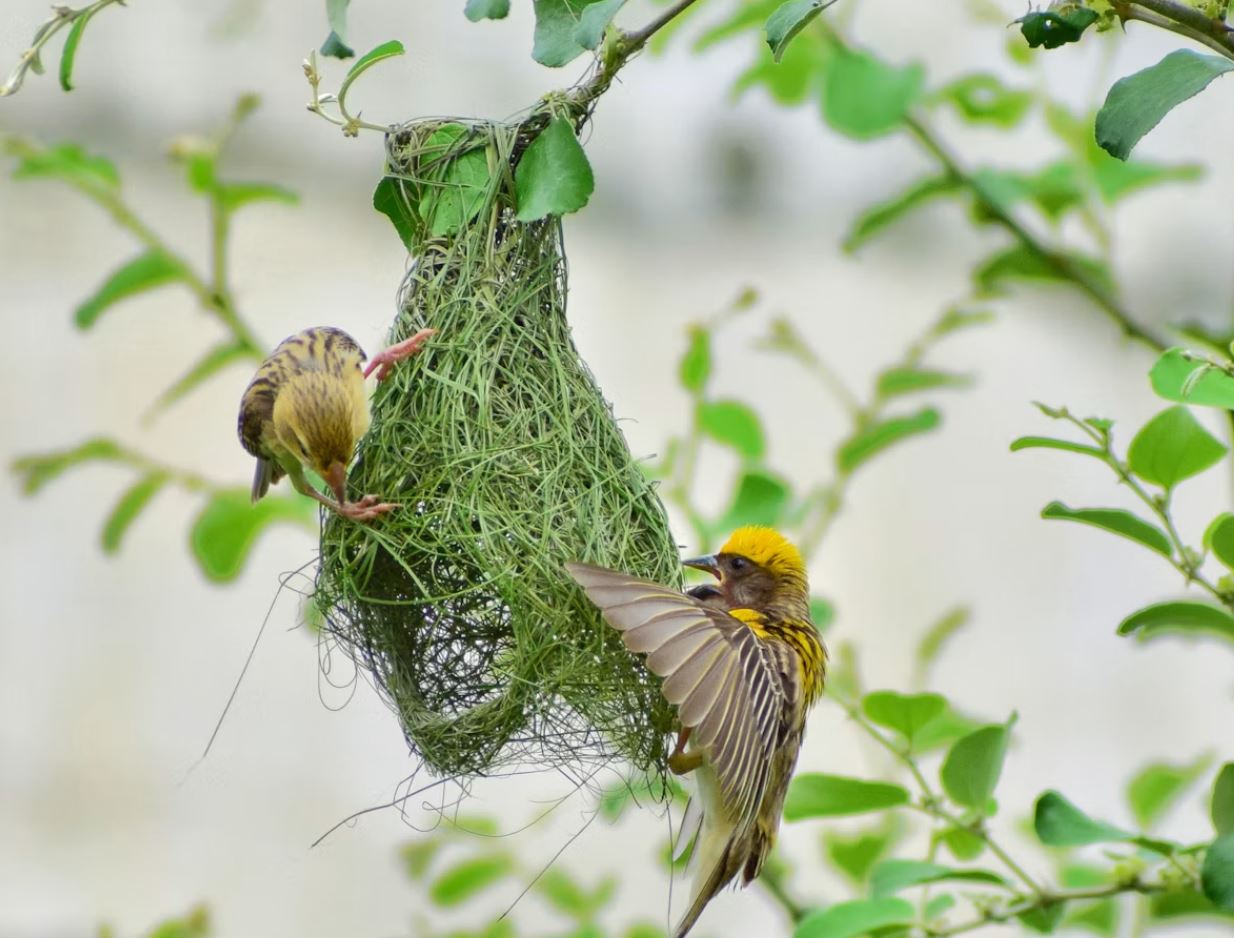
Pendant nests are intricate, sock-like pouches suspended from the thin, outer tips of high tree branches, demonstrating the pinnacle of avian textile engineering. Constructed primarily by tropical weaver birds, orioles, and sunbirds, these flexible hanging chambers sway gracefully in high winds while providing unparalleled protection against tree-climbing predators. By selecting thin, flexible branch tips as their anchor points, birds create an aerial sanctuary inaccessible to heavy snakes, monkeys, and lizards. The labor-intensive construction process requires birds to gather long, pliable plant fibers and tie hundreds of complex knots with their beaks to form a resilient, suspended nursery.
Overview & Typical Builders
- Common Species: Baltimore Orioles, Baya Weavers, Oropendolas, Sunbirds.
- Habitat Range: Tropical savannas, rainforests, and temperate deciduous woodlands.
Construction Materials
- Primary Fibers: Flexible grasses, palm leaf strips, bark threads, and vine tendrils.
- Structural Anchor: Spider webbing and plant down to securely knot the hanging loop.
Architectural Structure
- Suspended Pouch: Elongated bag shape with a narrow entry tunnel at the top or side.
- Woven Mesh: Intricate network of interlocked loops and knots.
Survival & Ecological Advantages
- Predator Isolation: Flexible twigs cannot support the weight of snakes or monkeys.
- Wind Resistance: Swaying movement dissipates structural force without breaking.
3. Cavity Nest
Cavity nests are completely enclosed hollow chambers located inside living or decaying tree trunks, wooden fence posts, or giant desert cacti, offering exceptional protection for vulnerable broods. Utilized extensively by woodpeckers, bluebirds, owls, and parrots, these sturdy timber fortresses provide superior insulation against scorching summer heat, freezing winter temperatures, and torrential rainstorms. Whether self-excavated by powerful-billed primary cavity nesters or inherited by secondary species, these enclosed wooden sanctuaries significantly boost survival rates. The narrow entrance portal acts as a formidable defensive bottleneck that parent birds can easily guard against aggressive competitors and large forest predators.
Overview & Typical Builders
- Common Species: Woodpeckers, Eastern Bluebirds, Screech Owls, Tree Swallows.
- Habitat Range: Old-growth forests, woodlands, orchards, and wooded parks.
Construction Materials
- Excavated Interior: Natural wood chips and damp sawdust left inside the cavity base.
- Secondary Padding: Soft grasses, animal fur, pine needles, and feathers added by occupants.
Architectural Structure
- Enclosed Chamber: Dark vertical shaft leading into an expanded bottom nursery space.
- Restricted Portal: Narrow entrance tailored precisely to the body diameter of the bird.
Survival & Ecological Advantages
- Climate Stability: Thick wooden walls buffer extreme heat and winter cold.
- Defensive Barrier: Small opening restricts large predators and keeps out heavy driving rain.
4. Platform Nest
Platform nests are expansive, flat structures constructed high above the ground on strong tree forks, coastal cliff ledges, or man-made utility platforms. Favored by large birds of prey like eagles, ospreys, and storks, these open timber pads serve as heavy-duty breeding sites built to endure extreme weather conditions over multiple years. Because these magnificent birds exhibit high site fidelity and return to the exact same nest every breeding season, they continuously add fresh branches, sticks, and sod. Over time, these continuous additions transform simple stick platforms into massive, multi-layered architectural monuments weighing hundreds or even thousands of pounds.
Overview & Typical Builders
- Common Species: Bald Eagles, Ospreys, White Storks, Great Blue Herons.
- Habitat Range: Coastal shorelines, river valleys, wetlands, and open plains.
Construction Materials
- Structural Base: Thick branches, heavy sticks, and large pieces of driftwood.
- Soft Bedding: Moss, turf, aquatic reeds, sod, and green leafy twigs.
Architectural Structure
- Flat Top: Expansive circular platform with a minor central dip for eggs.
- Multi-Layered Mass: Thick accumulated layers built up over multiple breeding seasons.
Survival & Ecological Advantages
- High Visibility: Elevated position lets birds monitor surrounding territories for danger.
- Heavy Capacity: Rigid structural base supports massive adult raptors and growing fledglings.
5. Scrape Nest
The scrape nest is the ultimate expression of avian minimalism, consisting of a shallow ground depression created without complex building materials or elaborate construction techniques. Utilized primarily by shorebirds, ground-dwelling game birds, and falcons, this simple nest relies entirely on natural terrain features and camouflage rather than physical walls. The parent bird presses its breast into loose sand, gravel, or soil to scrape out a small hollow that prevents eggs from rolling away. By skipping labor-intensive building, scrape nesters save immense energy while depending on the cryptically patterned, speckled shells of their eggs to blend invisibly into surrounding rocks.
Overview & Typical Builders
- Common Species: Killdeer, Peregrine Falcons, Arctic Terns, Common Ostriches.
- Habitat Range: Beaches, gravel bars, tundra plains, arid deserts, and open fields.
Construction Materials
- Unprocessed Substrate: Raw sand, pebbles, seashell fragments, and dry soil.
- Minimalist Rim: Occasional bits of driftwood, dry grass blades, or scattered stones.
Architectural Structure
- Shallow Indentation: Simple bowl shape scraped out by feet and body breast movement.
- Flush Profile: Blends directly into the surrounding flat terrain without raised edges.
Survival & Ecological Advantages
- Cryptic Camouflage: Eggs match surrounding rocks, making them nearly invisible from above.
- Energy Efficiency: Zero energy spent gathering distant building materials.
6. Mound Nest
Mound nests are massive earthen hills constructed directly on the ground using soil, sand, leaf litter, and decaying organic debris. Built by unique species such as Australian megapodes and flamingos, these elevated structures fulfill distinct survival needs based on their environment. For brush-turkeys and malleefowl, the heat generated by fermenting vegetation inside the deep compost mound acts as a natural incubator, eliminating the need for parents to sit on the eggs. Flamingos, on the other hand, build elevated mud cones to lift their single egg above tidal rising waters and hot, caustic mudflats, ensuring safety and thermal regulation.
Overview & Typical Builders
- Common Species: Malleefowl, Australian Brush-turkeys, Greater Flamingos.
- Habitat Range: Tropical rainforests, arid scrublands, and saline mudflats.
Construction Materials
- Earthen Mixture: Heavy mud, clay, topsoil, river sand, and leaf litter.
- Compost Core: Damp organic plant material rich in fermenting microbes.
Architectural Structure
- Conical Hill: Conical mound ranging from one-foot mud pedestals to giant dirt piles.
- Internal Chamber: Deeply buried central incubation space kept at stable temperatures.
Survival & Ecological Advantages
- Passive Heat: Compost fermentation eliminates the need for adult body incubation.
- Flood Resistance: Raised base protects eggs from ground runoff and high water tables.
7. Mud (Retort) Nest
Mud nests, often called retort nests due to their uncanny resemblance to glass laboratory flasks, are remarkably durable clay structures attached to vertical rock faces, cliff overhangs, and highway bridges. Constructed by swallows and magpies, these architectural wonders require birds to make thousands of energetic trips to collect individual wet mud pellets, which they meticulously combine with adhesive saliva. As the mud dries into rock-hard masonry, it forms a completely enclosed dome featuring a downward-pointing entrance tunnel. This sophisticated entrance tube successfully deters nest robbers, keeps out driving rain, and anchors securely to smooth, vertical surfaces.
Overview & Typical Builders
- Common Species: Cliff Swallows, Cave Swallows, Black-billed Magpies.
- Habitat Range: River canyons, mountain cliffs, highway bridges, and barn eaves.
Construction Materials
- Soil Pellets: Individual balls of clay and wet soil gathered near water sources.
- Natural Binder: Secreted saliva and small strands of straw or dry grass.
Architectural Structure
- Gourd Shape: Enclosed sphere featuring a downward-curved entry tunnel.
- Masonry Exterior: Hardened outer wall made of hundreds of dried mud pellets.
Survival & Ecological Advantages
- Physical Fortress: Hardened mud walls block larger predators from breaking through.
- Vertical Security: Attached to shear cliffs that mammalian carnivores cannot climb.
8. Burrow Nest
Burrow nests are subterranean tunnels excavated deep into sandy riverbanks, sea cliffs, grassy slopes, or soft soil beds by specialized digging birds. Utilized by kingfishers, puffins, burrowing owls, and sand martins, these underground sanctuaries offer an exceptionally stable microclimate that shelters eggs and nestlings from extreme temperature swings and heavy downpours. The birds use their specialized bills and strong feet to carve horizontal corridors that extend several feet into the earth before ending in a widened nesting pocket. Hidden completely underground, the vulnerable brood remains invisible and safe from flying raptors and surface-dwelling predators.
Overview & Typical Builders
- Common Species: Belted Kingfishers, Atlantic Puffins, Burrowing Owls, Bank Swallows.
- Habitat Range: Riverbanks, coastal sand dunes, sea bluffs, and open grasslands.
Construction Materials
- Excavated Soil: Native sand, clay, or silt dug out using bills and webbed feet.
- Cell Lining: Fish bones, shell fragments, dry grasses, or loose feathers.
Architectural Structure
- Horizontal Tunnel: Slanting corridor extending 3 to 10 feet into a vertical earthen bank.
- Terminal Nursery: Enlarged circular chamber at the end of the tunnel.
Survival & Ecological Advantages
- Microclimate Control: Underground position ensures steady temperatures day and night.
- Total Concealment: Deep entry points hide young entirely from airborne predators.
9. Adherent Nest
Adherent nests are specialized, bracket-like shelves glued directly onto vertical surfaces like cave walls, chimney flues, and dark hollow trees without the support of horizontal ledges. Crafted primarily by swifts and swiftlets, these minimalist structures rely on quick-drying, highly adhesive saliva secreted by enlarged salivary glands during the breeding season. The birds gather small twigs or feathers mid-flight and cement them together into a rigid lattice cup that adheres firmly to sheer stone or brick walls. This remarkable structural feat grants birds access to secluded, inaccessible vertical roosts where non-climbing ground predators simply cannot reach.
Overview & Typical Builders
- Common Species: Chimney Swifts, Vaux’s Swifts, Cave Swiftlets.
- Habitat Range: Dark caves, deep hollow trees, residential chimneys, and urban walls.
Construction Materials
- Short Twigs: Small branch tips snapped mid-flight by foraging birds.
- Sticky Saliva: Gelatinous fluid secreted by specialized sublingual glands.
Architectural Structure
- Half-Cup Bracket: Small, shallow shelf attached flat against a flat vertical wall.
- Lattice Weave: Interlocking twigs glued into a open-mesh bracket.
Survival & Ecological Advantages
- Wall Attachment: Requires no flat horizontal ledges or tree branches for support.
- Predator Exclusion: Placed inside smooth vertical shafts inaccessible to climbing mammals.
10. Sphere (Dome) Nest
Sphere or dome nests are fully enclosed, roofed structures shaped like hollow globes or footballs, featuring a single small entrance hole situated on the side. Constructed by cactus wrens, magpies, and ovenbirds, this comprehensive architectural design offers total overhead protection from intense desert sunlight, chilling winds, and heavy rainfall. The thick woven canopy conceals incubating adults and young chicks from overhead raptors, while the double-layered wall creates a warm, insulated microclimate. Built inside dense thorny bushes or high tree branches, these enclosed domes function as highly secure, weatherproof nurseries throughout the demanding breeding period.
Overview & Typical Builders
- Common Species: Cactus Wrens, Marsh Wrens, Black-billed Magpies, Ovenbirds.
- Habitat Range: Desert cactus thickets, dense reed marshes, brushy scrub, and open woods.
Construction Materials
- Outer Canopy: Coarse twigs, thorny branches, plant stems, and stiff grasses.
- Inner Insulation: Fine plant down, feathers, animal wool, and soft fur.
Architectural Structure
- Fully Roofed Globe: Complete spherical ball featuring a small side entrance portal.
- Double-Layer Wall: Tough protective outer shell paired with a soft inner lining.
Survival & Ecological Advantages
- Precipitation Shield: Overhanging roof prevents rain from soaking the internal nest cup.
- Overhead Protection: Completely obscures incubating parents from flying predators.
11. Communal (Compound) Nest
Communal nests are colossal, multi-family apartment complexes built by highly social birds like Sociable Weavers and Monk Parakeets, representing the ultimate form of cooperative animal architecture. These massive, thatched structures can span entire tree canopies or utility poles, housing dozens to hundreds of individual breeding pairs within separate, private internal compartments. By pooling their collective labor, the colony creates a massive thermal buffer that maintains comfortable interior temperatures during freezing desert nights and blistering hot days. Furthermore, living together in such large numbers provides continuous group vigilance, allowing birds to quickly detect and defend against incoming predators.
Overview & Typical Builders
- Common Species: Sociable Weavers, Monk Parakeets.
- Habitat Range: African savannas, arid plains, and suburban parks.
Construction Materials
- Heavy Roof Matrix: Large sticks, coarse twigs, and dry brushwood.
- Private Room Lining: Fine grasses, soft fibers, and fluffy seed heads.
Architectural Structure
- Apartment Complex: Single massive thatched structure containing numerous internal cells.
- Downward Entrances: Entry holes located on the underside to deter intruders.
Survival & Ecological Advantages
- Thermal Mass: Large collective volume maintains stable temperatures year-round.
- Group Vigilance: Hundreds of resident birds spot and warn against incoming predators.
12. Edible (Saliva) Nest
Edible nests are among the most extraordinary structural creations in the natural world, constructed almost exclusively from the pure, hardened salivary secretions of cave-dwelling swiftlets. Built high on the walls of pitch-black limestone cave systems across Southeast Asia, these translucent, crescent-shaped brackets contain virtually no plant matter or twigs. The swiftlets weave strands of viscous saliva that rapidly harden upon exposure to air, forming a durable, cup-like shelf anchored firmly to sheer rock faces. Protected deep within pitch-black caves, these unique nests keep broods safe from daytime predators and are famously harvested for culinary soup.
Overview & Typical Builders
- Common Species: Edible-nest Swiftlets, White-nest Swiftlets.
- Habitat Range: Coastal limestone caves across Southeast Asia and the Indo-Pacific.
Construction Materials
- Pure Mucus: Secretions from enlarged sublingual salivary glands that dry clear.
- Minimal Contaminants: Near-zero twigs or feathers in top-grade nests.
Architectural Structure
- Translucent Shelf: Small bracket anchored directly to shear, dark cave rock.
- Hardened Strands: Thread-like saliva layers woven and dried in high humidity.
Survival & Ecological Advantages
- Deep Cave Isolation: Built in total darkness inaccessible to daytime visual raptors.
- Parasite Reduction: Pure inorganic saliva limits bacterial growth and bug infestation.
13. Floating Nest
Floating nests are buoyant, raft-like platforms constructed directly on top of open water and loosely anchored to rooted aquatic plants like reeds, cattails, and bulrushes. Built by grebes, coots, and marsh terns, these floating structures rise and fall naturally with fluctuating water levels, preventing delicate egg clutches from being inundated during sudden flash floods. By surrounding their nesting site with open water, aquatic birds create a highly effective natural barrier against land-dwelling predators like foxes, raccoons, and snakes. The damp vegetation base stays soaked while the shallow central cup provides a dry, warm space for incubation.
Overview & Typical Builders
- Common Species: Pied-billed Grebes, American Coots, Black Terns.
- Habitat Range: Freshwater marshes, shallow lakes, ponds, and slow-moving rivers.
Construction Materials
- Saturated Vegetation: Cattails, reeds, bulrushes, and rotting pondweed.
- Tethering Anchors: Stems of living aquatic plants wrapped around the raft base.
Architectural Structure
- Buoyant Raft: Low-profile floating platform with a shallow central egg dip.
- Submerged Anchor: Large portion of decaying vegetation sits underwater for balance.
Survival & Ecological Advantages
- Water-Level Tracking: Rises and drops with changing water levels to prevent flooding.
- Land Predator Barrier: Surrounding open water keeps foxes, raccoons, and cats away.
14. Decayed Vegetation Mound Nest
Decayed vegetation mound nests are sophisticated composting incubators built on the humid forest floor by megapodes like the Australian Brush-turkey. By raking tons of damp leaf litter, soil, and organic debris into massive heaps, these birds harness the natural heat generated by microbial decomposition to incubate their buried eggs. The male bird continuously monitors the mound’s internal temperature using sensitive thermal receptors in his beak, adding or removing leaf layers to maintain a precise heat level. This remarkable adaptation frees the parent birds from body incubation, allowing chicks to hatch fully independent and ready to fly.
Overview & Typical Builders
- Common Species: Australian Brush-turkeys, Orange-footed Scrubfowl.
- Habitat Range: Dense tropical rainforests, damp eucalyptus woods, and coastal scrub.
Construction Materials
- Forest Floor Rake: Damp leaf litter, rich humus, fallen twigs, and topsoil.
- Fermenting Material: Microbe-rich organic compost that naturally generates heat.
Architectural Structure
- Massive Compost Heap: Broad dome up to 12 feet wide and 5 feet high.
- Ventilation Tunnels: Temporary shafts dug into the mound core for temperature control.
Survival & Ecological Advantages
- Automated Incubation: Microbial fermentation heat frees parents from sitting on eggs.
- Pre-Coated Protection: Chicks hatch fully feathered and capable of flight within hours.
15. Crevice Nest
Crevice nests are minimalist shelters built deep inside natural rock fissures, cliff fractures, wall cracks, or piles of mountain scree. Favored by rock doves, alpine swifts, and snow petrels, these secure rock pockets eliminate the need for elaborate material gathering or complex construction techniques. The surrounding solid stone offers impenetrable armor against severe weather like howling winds, driving rain, and hail, while completely obscuring the nest from hungry predators. Birds simply line the stone cavity with a few sparse twigs, moss, or feathers, creating an exceptionally protected and secluded nursery inside the natural mountain landscape.
Overview & Typical Builders
- Common Species: Rock Doves (Pigeons), Snow Petrels, Alpine Swifts, Nuthatches.
- Habitat Range: Mountain cliffs, boulder screes, sea bluffs, and urban stone masonry.
Construction Materials
- Minimalist Lining: A few scattered twigs, dry moss, grass stems, or feathers.
- Bare Stone Base: Unlined bedrock floor inside natural rock cracks.
Architectural Structure
- Narrow Fissure: Deep, narrow rock slit offering restricted entry space.
- Hidden Chamber: Shaded interior pocket tucked far behind the cliff entrance.
Survival & Ecological Advantages
- Solid Armor: Surrounding rock face protects against severe winds, rain, and hail.
- Predator Resistance: Tight rock gaps keep out large predatory birds and mammals.
Summary Comparison of Bird Nest Types
| Nest Type | Primary Builders | Key Materials Used | Primary Survival Advantage |
| Cup Nest | Robins, Hummingbirds | Twigs, mud, moss, spider silk | Holds eggs securely; provides insulation |
| Pendant Nest | Orioles, Weaver Birds | Woven grasses, plant fibers | Inaccessible to climbing mammals and snakes |
| Cavity Nest | Woodpeckers, Bluebirds | Wood chips, feathers, grass | Excellent weather isolation; small entry hole |
| Platform Nest | Eagles, Ospreys, Storks | Large branches, sticks, turf | Clear visibility; supports massive weight |
| Scrape Nest | Killdeer, Terns, Falcons | Gravel, soil, shell debris | Blends into ground; rapid, zero-cost setup |
| Mound Nest | Flamingos, Malleefowl | Mud, clay, composting leaves | Self-incubates or elevates above floodwaters |
| Mud Nest | Cliff Swallows | Mud pellets, saliva, straw | Durable masonry attached to vertical walls |
| Burrow Nest | Kingfishers, Puffins | Tunneled soil, root linings | Constant underground microclimate |
| Adherent Nest | Chimney Swifts | Small twigs, hardened saliva | Mounts on smooth vertical surfaces |
| Sphere Nest | Cactus Wrens, Magpies | Twigs, thorns, soft feathers | Fully enclosed roof shields from rain and sun |
| Communal Nest | Sociable Weavers | Sticks, woven grasses | Shared thermal insulation and group defense |
| Edible Nest | Swiftlets | Pure hardened saliva | Deep-cave protection from visual raptors |
| Floating Nest | Grebes, Coots | Aquatic reeds, marsh weeds | Prevents terrestrial land predators from access |
| Decayed Mound | Brush-turkeys | Damp leaf litter, rich humus | Microbial compost heat incubates eggs |
| Crevice Nest | Rock Doves, Snow Petrels | Minimal twigs, bare rock | Impenetrable stone shields from wind and rain |
Frequently Asked Questions
Why do different bird species build completely different nest shapes?
Nest architecture reflects millions of years of evolutionary adaptation tailored to specific biomes, body sizes, local materials, and predator risks. Ground nesters prioritize visual camouflage like scrapes, while woodland species build aerial hanging pouches or deep wood cavities to physically distance their offspring from climbing predators.
Do birds live in their nests all year round?
No, the majority of bird species use nests exclusively during the breeding season as temporary incubators for eggs and nurseries for hatchlings. Once chicks learn to fly and become independent, adult birds abandon the nest and sleep on roosting perches, tree cavities, or open water.
How do birds construct complex nests without being taught?
Nest building is an innate, genetically programmed instinct. Even birds raised in captivity without adult role models will successfully construct their species’ distinct nest architecture when breeding hormones rise, although older, experienced birds refine their technique over successive seasons.
Why do certain birds use spider silk in their nests?
Spider silk possesses extreme tensile strength and elastic flexibility. Birds like hummingbirds wrap spider silk around twigs and bark to bind the cup together, allowing the nest structure to stretch expandably as nestlings grow larger inside the cup.

- How to Grow Microgreens Without Soil Indoors: Easy Home Method - October 5, 2026
- Microgreens vs. Sprouts: Key Differences, Nutrition, Safety, and Which One to Eat - October 5, 2026
- 10 Best Garden Tools For Weed Removal 2027 - October 3, 2026