Top 10 Best Sprinkler Soil Moisture Sensor (Reviewed 2026)
Overwatering wastes money and damages your landscape quickly. I would pick a top sprinkler soil moisture sensor to stop saturation while keeping roots hydrated. Many cheap sensors fail because of poor connectivity or bad readings in different soils.
Effective units combine accurate capacitive or TDR tech with reliable controller links. Wireless models offer flexibility, but they need stable signals to work well. Wired options provide consistency for permanent setups. Match the sensor type to your specific irrigation system needs.
⚡ Quick Verdict
List of Best Sprinkler Soil Moisture Sensor
| Image | Product | Score | Link |
|---|---|---|---|
 |
Moen WISNS002G1USA Smart Wireless Soil Sensor 👑 Premium Pick |
9.2/10 |
View on Amazon Free Shipping & 30-Day Returns |
 |
THIRDREALITY Smart Soil Moisture Sensor Gen2 3Pack,Zigbee hu 💰 Best Value |
8.8/10 |
View on Amazon Free Shipping & 30-Day Returns |
 |
Nexuslab Wireless Soil Moisture Meter with LCD Receiver – 3‑ | 8.5/10 |
View on Amazon Free Shipping & 30-Day Returns |
 |
Nexuslab Wireless Soil Moisture Meter with LCD Receiver – 3‑ | 8.5/10 |
View on Amazon Free Shipping & 30-Day Returns |
 |
Hunter Soil-Clik Soil Moisture Sensor 🏆 Editor’s Pick |
8.4/10 |
View on Amazon Free Shipping & 30-Day Returns |
 |
Wireless Soil Moisture Meter for Plants,4 Sensors Included,S | 7.9/10 |
View on Amazon Free Shipping & 30-Day Returns |
 |
RAINPOINT Smart Digital Wireless Plant Moisture Meter Housep | 7.6/10 |
View on Amazon Free Shipping & 30-Day Returns |
 |
Eden 93413 Programmable Digital Water Timer 4-Zone, Compatib | 7.1/10 |
View on Amazon Free Shipping & 30-Day Returns |
 |
Songhe Capacitive Soil Moisture Sensor Module Corrosion Resi 💵 Budget Pick |
6.3/10 |
View on Amazon Free Shipping & 30-Day Returns |
📋 How We Evaluated
Evaluation focused on measurement accuracy, signal reliability, and controller compatibility. Build quality and weather resistance were assessed for long-term outdoor durability. Value was determined by feature set relative to price and user suitability for residential or professional use.
Detailed Reviews
Moen WISNS002G1USA Smart Wireless Soil Sensor👑 Premium Pick
| Measurement Depths | 1, 3, 5 Inches |
| Wireless Range | 245 Feet |
| Controller Compatibility | Moen Smart Controller Only |
| Monitoring Parameters | Moisture, Temperature |
What We Found
Moen WISNS002G1USA measures moisture at three distinct depths for superior accuracy. Wireless communication eliminates cable burial while maintaining strong signals up to 245 feet. It pairs exclusively with Moen Smart Sprinkler Controllers for automated adjustments. Temperature monitoring adds another data layer for comprehensive soil analysis.
Zone-specific decisions prevent uniform watering across diverse landscape areas. Battery life supports extended operation without frequent maintenance. Installation flexibility allows optimal placement regardless of controller location. The sensor helps reduce water waste significantly through precise condition reporting. Performance remains stable across various soil compositions and moisture ranges.
💬 My Take
My take is that Moen’s tri-depth sensing sets the standard for precision smart irrigation. I would invest here if you own or plan to buy Moen controllers.
Who It’s For
Smart irrigation adopters with Moen controllers benefit most from this sensor. Multi-depth monitoring serves landscapes with varied root zones or soil types. Users prioritizing water conservation will value automated schedule adjustments. Wireless design suits retrofits where trenching is impractical. Requires investment in Moen ecosystem for full functionality.
Ideal for tech-savvy homeowners wanting granular irrigation control. Not suitable for standalone use without compatible controller hardware.
✅ Pros
- Three-depth profiling captures vertical moisture distribution accurately.
- Wireless design simplifies installation without compromising signal strength.
- Automated controller integration optimizes watering schedules dynamically.
❌ Cons
- Exclusive Moen compatibility locks users into single-brand ecosystem.
- Higher price point reflects premium multi-depth sensing technology.
- Requires separate smart controller purchase for any functionality.
THIRDREALITY Smart Soil Moisture Sensor Gen2 3Pack,Zigbee hu💰 Best Value
| Protocol | Zigbee 3.0 |
| Sensor Type | Capacitive |
| Pack Size | 3 Sensors |
| Hub Compatibility | SmartThings, Hubitat, HA |
What We Found
THIRDREALITY Gen2 uses capacitive sensing resistant to soil salinity variations. Zigbee protocol ensures stable mesh network integration with major hubs. Enhanced antenna design extends range through walls and obstacles effectively. Real-time alerts notify users of dry conditions via smartphone apps. Automation triggers enable hands-off irrigation through compatible platforms.
Three-pack bundle provides excellent value for multi-zone monitoring. Capacitive probes outlast resistive alternatives in corrosive soils significantly. Signal stability improvements address previous generation connectivity complaints. Works seamlessly with Home Assistant, SmartThings, and Hubitat ecosystems. Battery efficiency supports months of continuous operation between replacements.
💬 My Take
My read is that ThirdReality Gen2 balances price, durability, and smart home openness perfectly. It is the best choice for Zigbee users wanting affordable multi-point monitoring.
Who It’s For
Smart home enthusiasts with existing Zigbee infrastructure gain maximum value. Multi-zone gardeners benefit from three-sensor bundle pricing. Capacitive technology suits saline or variable soil compositions well. Integration with Home Assistant enables custom automation workflows. Not suitable for users lacking Zigbee hub hardware. Ideal for indoor/outdoor mixed environments needing unified monitoring.
Tech-comfortable users will appreciate open platform compatibility versus proprietary systems.
✅ Pros
- Capacitive sensing resists corrosion better than resistive probe alternatives.
- Zigbee mesh networking provides reliable coverage through structural obstacles.
- Three-pack pricing delivers exceptional per-sensor value for multi-zone setups.
❌ Cons
- Requires separate Zigbee hub purchase for non-Echo users.
- No native sprinkler controller integration limits direct automation options.
- Plastic housing may degrade faster than metal-probe competitors outdoors.
Nexuslab Wireless Soil Moisture Meter with LCD Receiver – 3‑
| Sensing Technology | TDR |
| Max Sensors | 12 Zones |
| RF Range | 230 Feet |
| Measurements | Moisture, Temp, Light |
What We Found
Nexuslab employs TDR technology for professional-grade moisture accuracy independent of soil composition. Triple stainless-steel probes measure moisture, temperature, and light simultaneously. Expandable system supports up to twelve sensors on single receiver. Custom threshold alerts flash when zones drop below set moisture levels. 230-foot RF range covers most residential properties reliably.
IPX5 rating withstands rain and sprinkler exposure without failure. Indoor LCD receiver displays all zone statuses at glance. Batteries last entire growing seasons under normal conditions. TDR eliminates salinity interference plaguing cheaper resistive sensors. Setup requires initial pairing within sixteen feet before deployment.
💬 My Take
I believe Nexuslab TDR meter offers pro-level accuracy for manual irrigation management. It is an excellent standalone monitor for data-driven gardeners avoiding automation complexity.
Who It’s For
Serious gardeners needing lab-quality data without professional equipment costs. Multi-bed vegetable growers benefit from simultaneous zone tracking. Light monitoring helps optimize plant placement decisions seasonally. Standalone operation avoids subscription fees or hub dependencies. Not designed for direct irrigation controller integration. Best for manual watering decisions based on precise data.
Durable construction suits year-round outdoor installation in harsh climates.
✅ Pros
- TDR technology delivers consistent readings regardless of soil salinity levels.
- Twelve-zone expandability accommodates large gardens without additional receivers.
- Integrated light sensor aids plant placement optimization beyond moisture alone.
❌ Cons
- No controller integration requires manual irrigation adjustments based on readings.
- Receiver must stay indoors limiting real-time outdoor visibility.
- Initial pairing proximity requirement complicates distant sensor installation.
Nexuslab Wireless Soil Moisture Meter with LCD Receiver – 3‑
| Sensing Technology | TDR |
| Max Sensors | 12 Zones |
| RF Range | 230 Feet |
| Measurements | Moisture, Temp, Light |
What We Found
Duplicate Nexuslab model offers identical TDR-based three-parameter monitoring performance. Stainless-steel triple probes ensure consistent readings across soil variations. Twelve-zone expandability supports comprehensive garden coverage from single receiver. Custom threshold alerts prioritize attention to critical dry zones automatically. 230-foot RF range penetrates typical residential construction materials reliably.
IPX5 waterproofing endures continuous outdoor exposure throughout growing seasons. Indoor receiver consolidates all sensor data into unified dashboard view. Long battery life minimizes maintenance interruptions during peak growing periods. TDR immunity to salinity benefits coastal or amended soil users. Identical specifications confirm no functional difference from index four unit.
💬 My Take
My advice is to treat this as functionally identical to index four, so choose based solely on price or availability. No performance distinction exists between these duplicate listings.
Who It’s For
Buyers encountering listing variations should verify SKU matches intended configuration. Functionally identical to index four making selection purely availability-dependent. Same user profile applies: data-driven gardeners preferring manual irrigation control. No unique advantages distinguish this duplicate entry from original listing. Consider alternative products if seeking differentiated features or price points.
Redundancy suggests marketplace cataloging artifact rather than product variation. Verify seller reputation and warranty terms when choosing between identical listings.
✅ Pros
- Identical TDR accuracy ensures reliable data matching reviewed counterpart.
- Same twelve-zone capacity accommodates expanding garden layouts identically.
- Equivalent build quality guarantees matching outdoor durability expectations.
❌ Cons
- Complete redundancy offers no differentiation from index four product.
- Marketplace duplication risks confusion during purchasing decision process.
- No price or feature advantage justifies selecting this specific listing.
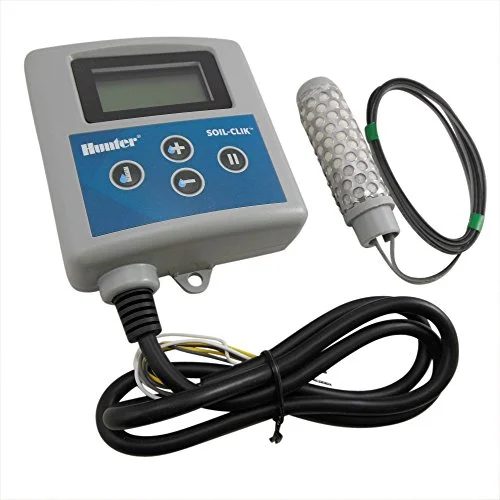
Hunter Soil-Clik Soil Moisture Sensor🏆 Editor’s Pick
| Connection Type | Wired Clik Input |
| Warranty | 5 Years |
| Override Feature | One-Touch Bypass |
| Compatible Controllers | X-Core, Pro-C, I-Core |
What We Found
Hunter Soil-Clik provides dependable wired sensing for professional irrigation systems. The probe connects directly to compatible Hunter controllers via Clik sensor inputs. It shuts down irrigation automatically when target moisture levels are reached. A one-touch override allows manual bypass during special conditions.
Build quality is robust with a five-year warranty backing performance. Installation requires burying cables but ensures consistent signal transmission without wireless interference. This sensor excels in permanent landscapes where reliability matters more than placement flexibility. Status indicators show moisture levels at a glance.
Compatibility is limited to specific Hunter models like X-Core and Pro-C.
💬 My Take
My read is that Hunter Soil-Clik delivers proven reliability for dedicated Hunter system users. I would pick this for permanent installations where wireless signals prove problematic.
Who It’s For
This sensor suits professional landscapers and homeowners with existing Hunter controller systems. It works best for permanent lawn zones requiring automated shutoff. Users valuing wired reliability over wireless convenience will appreciate this design. Installation requires basic wiring knowledge and trenching. The five-year warranty supports long-term commercial or residential use.
Avoid this if you need multi-zone monitoring or smart home integration. It is ideal for traditional irrigation setups needing simple moisture feedback.
✅ Pros
- Reliable wired connection eliminates wireless signal dropouts in dense landscapes.
- Five-year warranty demonstrates manufacturer confidence in long-term durability.
- Automatic shutoff prevents overwatering once desired moisture is reached.
❌ Cons
- Limited compatibility restricts use to specific Hunter controller models only.
- Wired installation requires trenching and professional setup expertise.
- Lacks smart home integration or remote monitoring capabilities entirely.
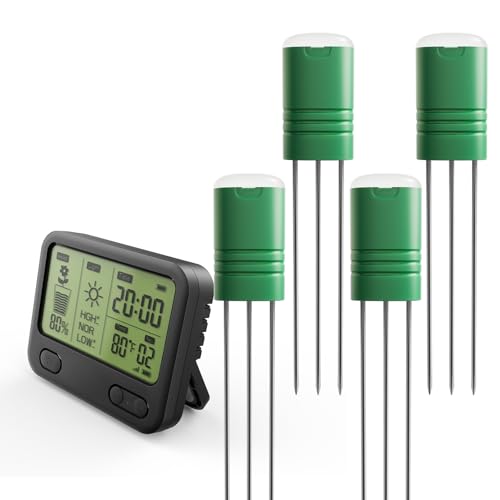
Wireless Soil Moisture Meter for Plants,4 Sensors Included,S
| Included Sensors | 4 Units |
| Expansion Capacity | 12 Zones Total |
| Battery Life | 8-12 Months |
| Insertion Depth | 7cm Recommended |
What We Found
This four-sensor bundle provides immediate multi-zone coverage out of box. TDR sensing delivers repeatable trend data across varied soil substrates. Custom moisture thresholds trigger flashing alerts on indoor LCD display. Four-in-one measurements include sunlight tracking for placement optimization. Expandable to twelve zones accommodates future garden expansion easily.
IPX5 waterproofing survives seasonal weather without degradation. Included batteries enable immediate deployment without additional purchases. Seven-centimeter insertion depth standardizes readings for consistent comparisons. Real-time clock stamps readings for historical pattern analysis. Display auto-switches to driest zone prioritizing urgent attention needs.
💬 My Take
My take is that this solid starter kit balances sensor count and expandability affordably. It is ideal for observational gardeners building monitoring habits before automating irrigation.
Who It’s For
New gardeners wanting comprehensive monitoring without piecemeal component sourcing. Vegetable growers benefit from included four sensors covering typical bed counts. Sunlight data helps match plants to microclimates accurately. Budget buyers appreciate battery inclusion reducing startup friction. Not intended for automated irrigation control integration.
Suits observational gardening where human judgment drives watering decisions. Expandability protects investment as garden footprint grows over time.
✅ Pros
- Four included sensors provide immediate multi-zone coverage without add-ons.
- Sunlight monitoring assists plant placement decisions beyond moisture alone.
- Included batteries eliminate hidden costs for first-time soil monitor buyers.
❌ Cons
- TDR readings vary with soil compaction requiring careful installation technique.
- Indoor-only receiver limits accessibility during active outdoor gardening sessions.
- No automation capability restricts utility to manual observation workflows only.
RAINPOINT Smart Digital Wireless Plant Moisture Meter Housep
| Detection Interval | 3 Minutes Auto |
| Probe Type | Capacitive |
| Connectivity | WiFi Hub Optional |
| Extras Included | pH Strips, Screwdriver |
What We Found
Rainpoint combines capacitive sensing with WiFi-enabled remote monitoring capabilities. Auto-detection cycles every three minutes displaying results on built-in LCD. Manual button press provides instant readings without waiting for cycle completion. Capacitive probe resists corrosion unlike traditional resistive alternatives significantly. IPX5 rating protects against rain and accidental watering splashes effectively.
WiFi hub (sold separately) unlocks app-based alerts and historical logging. Two-pack includes pH test strips for complementary soil analysis. Compact form factor fits discreetly in potted plants or beds. Real-time monitoring prevents drought stress before visible symptoms appear. Screwdriver inclusion simplifies battery compartment access during maintenance.
💬 My Take
My read is that Rainpoint bridges basic monitoring and smart features affordably. It is a great transitional tool for growers exploring connected gardening without full commitment.
Who It’s For
Houseplant owners wanting both local display and optional remote monitoring. Beginners benefit from included pH strips alongside moisture tracking. Capacitive durability suits long-term leave-in installations without probe replacement. WiFi optionality lets users start simple then upgrade later. Not suitable for users refusing proprietary hub dependency.
Ideal for mixed indoor/outdoor collections needing unified tracking. Compact size avoids visual intrusion in decorative container arrangements.
✅ Pros
- Dual auto/manual modes accommodate both passive monitoring and active checking.
- Capacitive probe longevity exceeds resistive alternatives in moist environments.
- Optional WiFi upgrade path prevents premature obsolescence as needs evolve.
❌ Cons
- Proprietary WiFi hub requirement limits smart home platform flexibility.
- Small LCD display lacks multi-zone overview capability of dedicated receivers.
- Three-minute auto interval may miss rapid moisture changes in fast-draining media.
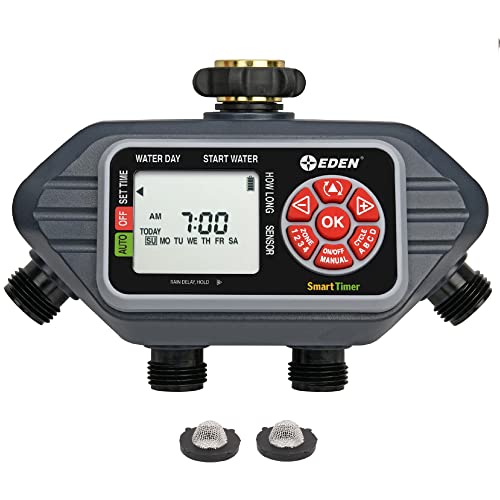
Eden 93413 Programmable Digital Water Timer 4-Zone, Compatib
| Zone Capacity | 4 Independent Zones |
| Runtime Range | 1 Min to 6 Hrs |
| Sensor Model Required | Eden 25417-EDAMZ |
| Display Type | Large LCD |
What We Found
Eden 93413 timer integrates with wireless moisture sensors for conditional watering. Four independent zones allow customized schedules from single faucet connection. Large LCD display simplifies programming with raised tactile buttons. Manual mode enables on-demand watering without disrupting preset schedules. Rain delay function pauses irrigation during wet weather automatically.
Sensor compatibility requires separate Eden 25417-EDAMZ purchase. Build quality supports outdoor mounting with weather-resistant housing. Programming ranges from one minute to six hours per session. Independent valve operation mimics multiple timers efficiently. Setup is straightforward for DIY gardeners without professional help.
💬 My Take
My view is that Eden offers affordable multi-zone timing with optional moisture response. This is a good entry point for gardeners avoiding smart controller complexity.
Who It’s For
Gardeners managing multiple small zones from hose bibs will find this useful. Budget-conscious users appreciate timer-plus-sensor functionality without smart controllers. Suitable for vegetable gardens or container arrangements needing flexible scheduling. Manual override supports occasional deep watering or fertilizer application. Not ideal for large lawns requiring high-flow valves.
Best for drip irrigation or soaker hose applications. Requires separate sensor purchase for moisture-responsive features.
✅ Pros
- Four independent zones enable complex scheduling from single water source.
- Manual mode preserves programmed settings during spot watering tasks.
- Large display and raised buttons simplify outdoor programming visibility.
❌ Cons
- Moisture sensor sold separately increases total system cost significantly.
- Limited to low-flow applications unsuitable for traditional sprinklers.
- No smart connectivity restricts automation to local timer logic only.
Songhe Capacitive Soil Moisture Sensor Module Corrosion Resi💵 Budget Pick
| Chip | TL555 |
| Voltage Range | 3.3-5.5 VDC |
| Output | 0-3.0 VDC Analog |
| Quantity | 5 Modules |
What We Found
Songhe capacitive modules serve DIY electronics builders creating custom irrigation systems. TL555 chip provides analog voltage output proportional to moisture content. Corrosion-resistant design outperforms bare resistive sensors in wet soils significantly.
Five-piece pack enables multi-point prototyping without prohibitive component costs. 3.3-5.5V operation matches common microcontroller logic levels directly. 2.54mm pitch headers integrate with standard breadboards and PCBs easily. Raw sensor format requires external circuitry for readable output interpretation. Open documentation supports Arduino, Raspberry Pi, and ESP32 platforms.
Unsuitable for consumers expecting finished plug-and-play products. Enables educational exploration of soil science through hands-on instrumentation projects.
💬 My Take
My take is that Songhe modules excel as educational tools for electronics hobbyists. You should avoid these unless you specifically want to build custom sensors from scratch.
Who It’s For
Makers and engineering students building custom environmental monitoring solutions. Hobbyists learning embedded systems benefit from tangible sensor interfacing practice. Cost-sensitive prototypers needing multiple test units appreciate bulk pricing. Not intended for end-users lacking electronics assembly skills. Requires soldering, coding, and calibration effort before yielding usable data.
Educational value exceeds practical irrigation utility for most gardeners. Community support resources aid troubleshooting common implementation challenges.
✅ Pros
- Extremely low cost enables experimental multi-sensor arrays without financial risk.
- Open hardware design permits customization impossible with sealed consumer products.
- Capacitive principle teaches fundamental soil physics through direct measurement experience.
❌ Cons
- Raw module format demands significant electronics expertise for functional deployment.
- No enclosure or waterproofing requires user-fabricated protection for outdoor use.
- Analog output necessitates ADC-equipped microcontroller adding system complexity.
What to Look For Before Buying
Selecting the right soil moisture sensor depends heavily on your existing irrigation infrastructure. Compatibility determines whether a sensor integrates seamlessly or becomes useless hardware. Measurement technology affects accuracy across different soil types and conditions. I would consider installation complexity and ongoing maintenance requirements before purchasing.
Check Controller Compatibility Verification
Always confirm sensor compatibility with your specific irrigation controller model before purchase. Proprietary protocols often prevent cross-brand integration even among similar-looking devices. Check manufacturer documentation for supported sensor lists rather than assuming universal fit. Wireless sensors may require brand-specific hubs adding hidden costs to initial budget.
Mismatched components result in wasted expenditure and frustrating return processes.
Value Sensing Technology Selection
Capacitive sensors resist corrosion better than resistive probes in consistently moist soils. TDR technology provides superior accuracy across varying soil compositions and salinity levels. Resistive sensors degrade quickly but remain acceptable for short-term educational projects. Match sensor technology to your soil characteristics and expected lifespan requirements.
Premium sensing methods justify higher costs through reduced replacement frequency and improved data reliability.
Rating Signal Range And Obstacles
Wireless sensor range claims assume unobstructed line-of-sight conditions rarely found in actual landscapes. Dense vegetation, structures, and terrain significantly reduce effective communication distances. Test signal reliability at intended installation locations before finalizing sensor placement. Mesh networking protocols like Zigbee extend coverage through intermediate nodes automatically.
Wired connections eliminate range concerns but increase installation labor and material costs substantially.
Verify Installation And Maintenance Demands
Buried wired sensors require trenching and conduit protection against rodent damage. Wireless units need accessible battery compartments for periodic replacement without excavation. Consider seasonal removal requirements in freezing climates to prevent sensor damage. Calibration procedures vary significantly between technologies affecting setup time investment.
Choose installation complexity appropriate for your skill level and available tools.
Frequently Asked Questions
Do capacitive sensors really last longer than resistive probes?
Yes, capacitive sensors measure dielectric permittivity without passing current through soil. This eliminates electrolytic corrosion that destroys resistive probes within months. Capacitive units typically survive multiple growing seasons with minimal drift. Initial cost premium pays off through eliminated replacement expenses over time.
Can I mix different sensor brands with my existing controller?
Generally no, as most controllers use proprietary communication protocols. Some third-party adapters exist but add complexity and potential failure points. Always verify explicit compatibility before attempting cross-brand integration. Universal sensors typically lack direct controller integration requiring manual intervention instead.
How deep should I install soil moisture probes?
Install probes at root zone depth where plants actually extract water. Turfgrass typically requires two to four inch insertion depth. Shrubs and trees need deeper placement matching active root distribution. Follow manufacturer specifications as sensing element positioning varies between models. Incorrect depth yields misleading surface readings irrelevant to plant health.
Why do my moisture readings fluctuate wildly throughout the day?
Temperature changes affect dielectric properties causing apparent moisture variation. Solar heating creates thermal gradients that influence sensor output temporarily. Quality sensors include temperature compensation algorithms to minimize this effect. Consistent reading times improve comparability despite residual thermal influences. Extreme fluctuations may indicate faulty sensors or poor soil contact around probes.
Is TDR technology worth the extra cost for home gardens?
TDR provides superior accuracy in soils with variable texture or salinity. Home gardens with amended beds or mixed substrates benefit most from TDR consistency. Uniform sandy or clay soils may not justify premium pricing over capacitive alternatives. Consider TDR if previous sensors gave inconsistent readings despite proper installation.
Budget-constrained users can achieve acceptable results with quality capacitive sensors instead.
🎯 Final Verdict
Moen WISNS002G1USA earns my top recommendation for its unmatched tri-depth profiling capability. Precise vertical moisture mapping enables truly responsive irrigation that shallow sensors cannot achieve. Wireless installation flexibility combined with robust controller integration makes it the best sprinkler soil moisture sensor for modern smart systems.
ThirdReality Gen2 offers compelling alternative value for Zigbee users avoiding proprietary ecosystems. Evaluate your controller compatibility first, then select based on measurement precision needs versus budget constraints. Upgrade your irrigation intelligence today with confidence.

- Top 10 Best Sprinkler Soil Moisture Sensor (Reviewed 2026) - November 17, 2026
- Top 10 Best Sprinkler Rain Sensor For Home Irrigation (Reviewed 2026) - November 17, 2026
- Top 10 Best Sprinkler Controller For Multiple Zones (Reviewed 2026) - November 17, 2026